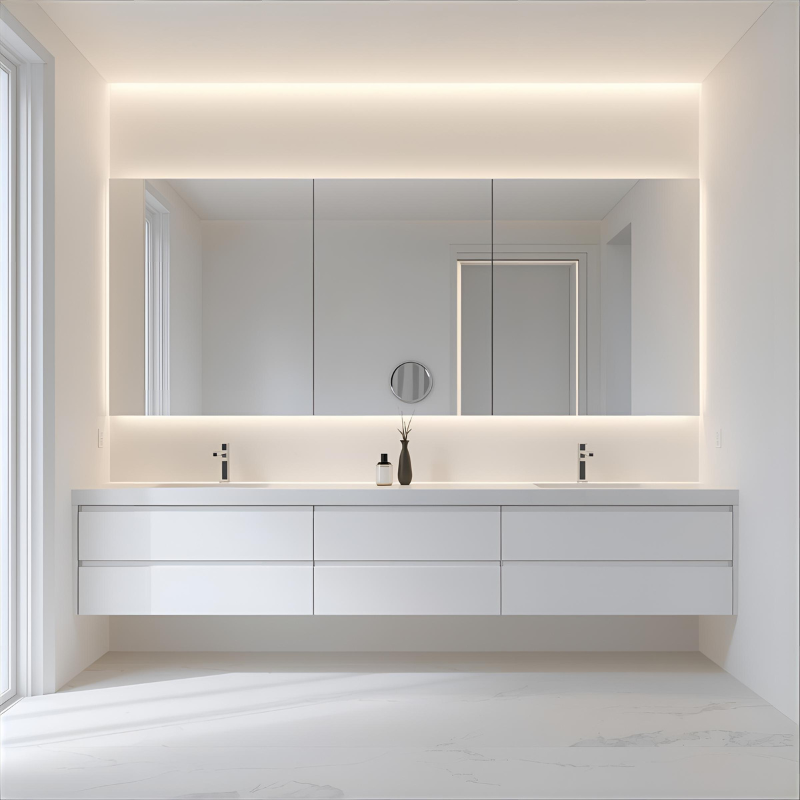
Standard, Semi‑Custom and Fully‑Custom Bathroom Vanities: Strategic Choices for Retailers & Importers
Published: May 28, 2026
▼ Table of Contents (Click to expand)
Introduction
Defining Standard, Semi‑Custom and Fully‑Custom Bathroom Vanities
Core Benefits of Standardized Vanity Lines for Retailers
2.1 Streamlined Inventory & SKU Governance
2.2 Fast Turnaround and Improved Conversion Rates
2.3 Predictable Cost Structure & Competitive Price Positioning
2.4 Simplified After‑Sales Support & Spare‑Parts Management
2.5 Scalable Expansion Across Multi‑Channel Retail
Key Business Advantages of Fully‑Custom Bathroom Vanities
3.1 Build Differentiation and Escape Commodity‑Driven Price Wars
3.2 Lift Average Order Value and Gross Profit Margins
3.3 Serve High‑End Homeowners, Designers and Commercial Project Buyers
3.4 Elevate Retailer Brand Positioning as Bathroom Solution Experts
Inherent Business Risks When Relying Purely on Standardized Stock Products
4.1 Intense Homogenization and Price‑Driven Competition
4.2 Mismatch Between Standard Sizes and Real‑World Bathroom Layouts
4.3 Inventory Misjudgment Can Trigger Heavy Overstock Burdens
4.4 Limited Brand Distinctiveness Without Extra Marketing Investment
Operational Challenges When Offering Fully‑Custom Vanity Services
5.1 High Labour‑Intensive Pre‑Sales Communication & Confirmation Work
5.2 Extended Production Lead Times Impacting Customer Expectations
5.3 Elevated After‑Sales and rework Risks for Non‑resalable Made‑to‑order Goods
5.4 Strict Demands Placed On Your Manufacturing Supply‑Chain Partner
Comparative Matrix: Standard vs Fully‑Custom Bathroom Vanities
What Is Semi‑Custom Vanity? Why It Is The Fastest‑Growing Middle‑Ground Option
Recommended Product Mix Strategies By Retailer Business Model
8.1 Large‑Format Chain Retailers
8.2 E‑Commerce & Marketplace Retailers (Wayfair, Amazon, Independent Sites)
8.3 Physical Showroom‑Based Retailers
8.4 Retailers Focused On Designer & Interior‑Design Channels
8.5 Contractors, Remodeling Firms and Trade‑Focused Resellers
8.6 Luxury Boutique Bathroom Retailers
Shifting Consumer & Commercial Trends Reshaping Retail Product Roadmaps
9.1 Shoppers Are Purchasing Complete Bathroom Ecosystems, Not Isolated Cabinets
9.2 Growing Consumer Appetite For Personalized Storage and Layout Options
9.3 Low‑Maintenance, Stain‑Resistant Materials Become Priority Buying Criteria
9.4 Digital Pre‑Purchase Research Drives Online Expectations For All Retail Touchpoints
9.5 Delivery Lead Times Directly Impact Project Conversion and Customer Satisfaction
How Manufacturers Can Support Retailers Across Standard, Semi‑Custom and Custom Segments
10.1 Manufacturer Best Practices For Standard‑Focused Retail Partners
10.2 Manufacturer Best Practices For Custom‑Oriented Retail Partners
Will The Hybrid Mixed‑Portfolio Model Dominate Vanity Retail In Coming Years?
Final Key Takeaways
Introduction
For bathroom vanity retailers, importers and trade resellers, there is no universal “better” choice between standard stock goods and fully‑custom made‑to‑order production. Your optimal product mix depends entirely on your sales channels, target customer demographics, inventory capacity, lead‑time commitments and overall profit‑making objectives.
To summarise core positioning:
Standardized vanities excel for high‑volume sales, tight cost control, fast fulfilment and broad‑reach online retail.
Fully‑custom vanities deliver higher margins, differentiated offerings and serve high‑end residential and commercial project clients.
Semi‑custom modular solutions represent the fast‑growing pragmatic middle path for most modern bathroom retail businesses.
According to NKBA 2026 bathroom industry research, today’s bathroom is evolving from purely utilitarian washing space toward wellness‑focused personal zones. Homeowners increasingly value configurable storage, integrated smart features, coordinated lighting and material selections tailored to individual household habits. At the same time, renovation timelines remain tight, and many customers still expect reasonably quick product delivery. This tension creates both challenges and new commercial opportunities for vanity retailers.
1. Defining Standard, Semi‑Custom and Fully‑Custom Bathroom Vanities
Standardized bathroom vanities are mass‑produced pre‑defined units with fixed widths, depths, door styles, colours, countertop‑sink combinations and hardware. They are assigned fixed SKUs, pre‑packaged and held ready‑to‑ship in warehouse stock. Typical standard sizes include 24‑inch, 30‑inch, 36‑inch, 48‑inch and 60‑inch widths, paired with popular finishes such as white, light grey, oak and walnut. The core logic of standard goods is leveraging repeatable production workflows to raise throughput and simplify inventory oversight.
Fully‑custom bathroom vanities are manufactured from project‑specific specifications. Buyers can adjust nearly every variable: exact cabinet dimensions, door profiles, paint or veneer colour, substrate material, countertop and sink type, internal drawer layout, hardware selection, mounting style and cut‑outs for unique plumbing conditions. Each order is produced individually after detailed requirement confirmation.
Semi‑custom bathroom vanities sit between the two above categories. Built upon standardized base cabinet modules, they offer controlled menus of configurable options without full ground‑up custom engineering. Examples include fixed cabinet carcass with optional finish colours, selectable countertop upgrades, interchangeable drawer inserts or matching add‑on mirror and side cabinet combinations.
2. Core Benefits of Standardized Vanity Lines for Retailers
2.1 Streamlined Inventory & SKU Governance
Standard products enable clean, predictable SKU management. Retailers can analyse historical sales data to identify high‑velocity sizes, colours and configurations and concentrate warehouse stock on proven‑selling items. For bulky furniture like bathroom vanities, warehouse space and capital are precious resources; well‑managed standard SKUs prevent excessive inventory fragmentation. Common top‑selling stock configurations are 36‑inch single‑sink white vanities, 48‑inch oak‑finish units and 60‑inch double‑sink models.
2.2 Fast Turnaround and Improved Conversion Rates
Since standard vanities are pre‑manufactured and warehoused, orders can ship immediately without waiting for drawing review, material sourcing or dedicated production runs. Fast availability is a major conversion driver for e‑commerce platforms, home‑improvement marketplaces and brick‑and‑mortar home‑goods stores, especially for time‑sensitive renovation schedules.
2.3 Predictable Cost Structure & Competitive Price Positioning
Mass‑volume production allows factories to realise economies of scale on raw‑material procurement, assembly work and export‑ready packaging. Retailers receive stable, repeatable purchasing costs, making standard lines well‑suited for price‑sensitive mid‑market consumers, promotional campaigns and clearance events.
2.4 Simplified After‑Sales Support & Spare‑Parts Management
Hardware, drawer slides, sinks, countertops and door components are consistent per‑SKU. When damage or defects occur, support teams can rapidly identify required replacement parts, without digging through unique custom‑order records. Issues such as broken drawer slides, scratched door panels or cracked sinks become much faster to resolve.
2.5 Scalable Expansion Across Multi‑Channel Retail
If your business goal is to grow across multiple sales channels including Amazon, Wayfair, independent B2C websites and offline chain partners, standardized SKUs are far easier to replicate across marketplaces. Their strength is not maximum uniqueness, but proven market fit, stable quality and manageable end‑to‑end operations.
3. Key Business Advantages of Fully‑Custom Bathroom Vanities
3.1 Build Differentiation and Escape Commodity‑Driven Price Wars
Standard stock vanities can be easily copied by competing retailers; shoppers often end‑up comparing nothing except price, review scores and delivery speed. Custom offerings allow retailers to shift their value proposition “from selling boxes to delivering complete bathroom space solutions”. Custom builds solve real‑world pain‑points: irregular‑sized bathrooms, special high‑end interior design requirements, hotel‑apartment project specifications that cannot be satisfied by off‑the‑shelf product ranges.
3.2 Lift Average Order Value and Gross Profit Margins
Fully‑custom projects are rarely decided purely on lowest price. Homeowners and project stakeholders will pay premium pricing for dimension matching, bespoke finishes, upgraded materials, custom storage layouts and coordinated space results. Multiple revenue streams open‑up for retailers: design consultation fees, material upgrade surcharges, countertop and hardware upgrades, installation and project management service fees.
3.3 Serve High‑End Homeowners, Designers and Commercial Project Buyers
Custom vanity solutions resonate strongly with interior designers, renovation contractors, hotel‑apartment developers, luxury residential clients and real‑estate show‑home projects. These buyers place higher priority on space fit, design coherence and reliable project execution than on lowest unit price.
3.4 Elevate Retailer Brand Positioning as Bathroom Solution Experts
When you deliver custom services including dimension guidance, material recommendation, drawing validation and project tracking, you position your business beyond a simple goods reseller. You become a trusted bathroom‑solution provider, an enormous asset for showroom operations, B2B wholesale and trade‑channel development.
4. Inherent Business Risks When Relying Purely on Standardized Stock Products
The primary risks of a standard‑only strategy are product homogenisation and costly inventory mis‑judgement.
4.1 Intense Homogenization and Price‑Driven Competition
Large numbers of retailers may stock near‑identical white, grey and oak‑toned standard vanities. This pushes the marketplace toward price‑cutting and compresses gross profit margins.
4.2 Mismatch Between Standard Sizes and Real‑World Bathroom Layouts
Real‑world bathrooms feature variable wall widths, offset plumbing positions, pipe obstructions and unique mirror‑cabinet coordination constraints. Popular standard dimensions cannot accommodate every residential or commercial layout, creating lost sales opportunities.
4.3 Inventory Misjudgment Can Trigger Heavy Overstock Burdens
Standardization does not eliminate inventory risk entirely. Misreading colour trends, local market dimension preferences or seasonal demand shifts can leave retailers holding slow‑moving overstock that locks‑up cash‑flow and consumes valuable warehouse floor‑space.
4.4 Limited Brand Distinctiveness Without Extra Marketing Investment
Without strong proprietary design work, premium packaging, brand storytelling and high‑quality content marketing, generic standard‑SKU vanities risk being perceived as interchangeable commodity goods. Retailers leaning heavily on standard ranges must compensate via consistent quality control, robust export‑grade packaging, fast logistics and rich product imagery and documentation.
5. Operational Challenges When Offering Fully‑Custom Bathroom Vanities
The biggest hurdle of custom vanity business is dramatically increased operational complexity across pre‑sales, production and post‑sales workflows.
5.1 High Labour‑Intensive Pre‑Sales Communication & Confirmation Work
Custom orders demand detailed back‑and‑forth confirmation covering exact dimensions, finish samples, countertop‑sink specifications, hardware selections, plumbing cut‑out positions and installation boundary‑conditions. Even one misunderstood detail can generate rework costs, customer complaints and project delays.
5.2 Extended Production Lead Times Impacting Customer Expectations
Custom units cannot ship from existing inventory. They require requirement confirmation, material ordering, dedicated manufacturing, QC inspection and final packing. Retailers must carefully manage lead‑time expectations with consumers and trade clients, or customer satisfaction will suffer.
5.3 Elevated After‑Sales and rework Risks For Non‑resalable Made‑to‑order Goods
Unlike standard stock inventory, completed custom vanities generally cannot be resold to another buyer if specifications are wrong, colours disappoint or requirements change mid‑project. Mistakes translate directly into financial losses.
5.4 Strict Demands Placed On Your Manufacturing Supply‑Chain Partner
Success with custom offerings depends entirely on your factory’s flexible‑production capabilities. Critical supplier competencies include rapid sampling, small‑batch manufacturing, multi‑colour and multi‑size management, formal drawing‑confirmation workflows, traceable order tracking and consistent quality‑control protocols. Weak manufacturing partners transfer all complaint‑handling pressure directly onto the retail reseller.
6. Comparative Matrix: Standard vs Fully‑Custom Bathroom Vanities
Comparison Dimension | Standardized Bathroom Vanity | Fully‑Custom Bathroom Vanity |
|---|---|---|
Core Operating Logic | Fixed‑definition SKU, mass‑volume sales | Designed and manufactured per individual client requirements |
Most‑Suited Sales Channels | E‑commerce marketplaces, chain stores, wholesale‑warehouse trade | Physical showrooms, designer networks, commercial‑project and luxury retail |
Product Characteristics | Fixed sizes, finishes, countertops and hardware | Sizes, materials, finishes and internal layouts fully adjustable |
Cost Management | Highly predictable unit costs | Variable costs depending on material and complexity |
Delivery Lead‑Time | Very fast; available from warehouse stock | Longer lead‑time; requires confirmation plus dedicated production cycle |
Inventory Exposure | Requires stock holding; occupies warehouse capacity | Minimal finished‑goods inventory burden, but complex order administration |
Profit Profile | Lower per‑unit margin; profitability driven by sales volume | Higher per‑unit margin; profitability driven by solution value |
Sales Complexity | Straightforward catalogue‑based selling | Requires skilled sales‑staff with design and specification knowledge |
After‑Sales Complexity | Low; uniform spare‑parts inventory available | High; specification errors carry high financial consequence |
Product Differentiation | Limited; easy for competitors to duplicate | Strong capability to deliver unique space‑matched solutions |
Target Customer Profile | Budget‑aware buyers prioritising quick delivery | Buyers with special‑size, design‑driven or project‑based requirements |
Required Manufacturer Capabilities | Stable mass‑production, consistent quality, reliable shipment | Flexible small‑batch capacity, drawing‑review process, custom QC workflows |
Key Retailer Risks | Over‑stocking risk, price‑compression | Delivery‑schedule slippage, specification mis‑communication, costly rework |
7. What Is Semi‑Custom Vanity? Why It Is The Fastest‑Growing Middle‑Ground Option
Semi‑custom operates on top of standardized cabinet modules, delivering limited, controlled menus of configurable options rather than full ground‑up custom design. Typical semi‑custom examples:
Fixed cabinet carcass structure with multiple selectable finish colours
Fixed base cabinet sizes with upgrade options for countertop material
Standard door‑style offering with interchangeable drawer‑storage configurations
Consistent main cabinet series with optional handles, mirror‑cabinets and tall side‑storage combinations
The core value proposition of semi‑custom: leverage standardized factory production workflows to deliver customer experience close to full customisation, while keeping complexity and costs manageable.
Three primary drivers behind its market growth:
Modern homeowners increasingly expect storage and styling tailored to household living habits. NKBA industry survey data indicates most trade professionals report rising demand for configurable vanity storage modules and integrated power‑outlet features.
Retail businesses crave product differentiation but cannot absorb the heavy operational and after‑sales risks inherent in 100% fully‑custom order‑flow.
Manufacturing partners can control complexity and material waste by building upon existing modular cabinet platforms, generating variant products without completely re‑engineering every single order.
In short: semi‑custom strikes a practical balance, offering greater flexibility than pure stock goods yet far more controllable operations compared with unrestricted full custom projects.
8. Recommended Product Mix Strategies By Retailer Business Model
8.1 Large‑Format Chain Retailers
Recommended mix: Mainly standard product lines plus limited semi‑custom selectionsLarge‑chain operations require high inventory turnover, predictable stock accuracy and dependable delivery performance. Focus your assortment around proven standard vanity widths (24 / 30 / 36 / 48 / 60 inch). Restrict colour selections to high‑demand neutrals: white, grey, oak, walnut. Offer limited upgrade choices for countertops and mirror‑cabinet add‑ons. Prioritise robust transport‑resistant packaging and fast order fulfilment.
8.2 E‑Commerce & Marketplace Retailers (Wayfair, Amazon, Independent Sites)
Recommended mix: Heavy emphasis on well‑defined standard SKUs with clear product documentationOnline marketplaces penalise ambiguous options, high return‑rates and unclear specifications. Each SKU must feature complete dimension drawings, installation schematics, package dimensions, high‑resolution lifestyle imagery and explicit option descriptions. Minimise open‑ended custom‑request pathways. Provide installation videos and written guides. Focus resources on product reviews, logistics reliability and spare‑parts support.
Industry market statistics show the US home‑improvement market continues expanding, with online channels ranking among the fastest‑growing segments of the sector.
8.3 Physical Showroom‑Based Retailers
Recommended mix: Semi‑custom as primary offering, supplemented with full‑custom for premium projects and standard display samplesPhysical showrooms can present physical material swatches, countertop samples and door‑finish boards. Sales consultants can explain value‑added design services to visiting clients. Deploy standard vanities as display examples, use semi‑custom for most mainstream sales, and deploy fully‑custom capabilities for high‑end special‑requirement projects.
8.4 Retailers Focused On Designer & Interior‑Design Channels
Recommended mix: Fully‑custom paired with premium semi‑custom modular systemsInterior‑design professionals frequently need products harmonised with complete interior‑space concepts; standard catalogue items often cannot satisfy unique dimension, material or aesthetic demands. Supply CAD drawings or technical render outputs, support special finishes and bespoke dimension work, build‑out organised material‑and‑sample libraries and implement formal project quotation workflows.
8.5 Contractors, Remodeling Firms and Trade‑Focused Resellers
Recommended mix: Standard core range plus semi‑custom for special‑layout jobsContractor clients value dependable delivery, straightforward installation and minimal after‑sales trouble. Standard SKUs serve routine renovation assignments efficiently. Deploy semi‑custom solutions to resolve non‑standard site‑layout challenges. Provide volume‑based project pricing and installation‑friendly cabinet construction and packaging.
8.6 Luxury Boutique Bathroom Retailers
Recommended mix: Primarily fully‑custom vanity offeringsCompetitive advantage for boutique luxury retailers lies not in low price‑points but bespoke design, premium‑grade materials, attentive service and product uniqueness. Concentrate on upscale finishes, premium stone countertops, concealed storage organisation, smart‑mirror‑cabinet and integrated‑lighting solutions. Emphasise design‑consulting and complete‑space solutions; focus on raising average customer value rather than pure unit sales volume.
9. Shifting Consumer & Commercial Trends Reshaping Retail Product Roadmaps
9.1 Shoppers Are Purchasing Complete Bathroom Ecosystems, Not Isolated Cabinets
Today’s buyers evaluate whole‑bathroom coordination: vanity unit, LED mirror cabinet, side storage cabinets, faucets, countertop‑sink combinations and unified space aesthetic. Retailers benefit from selling coordinated series bundles rather than only single standalone vanity cabinets.
9.2 Growing Consumer Appetite For Personalized Storage and Layout Options
Modern homeowners desire drawers, divided compartments, charging outlets and storage adapted to personal grooming habits. Generic one‑size‑fits‑all stock‑vanity interior layouts no longer satisfy many buyers.
9.3 Low‑Maintenance, Stain‑Resistant Materials Become Priority Buying Criteria
Appearance alone is insufficient. End‑users actively seek easy‑clean countertops, moisture‑stable cabinet substrates, wear‑resistant surface finishes and stain‑resistant sink solutions. Long‑term low‑upkeep performance has become a meaningful selling argument.
9.4 Digital Pre‑Purchase Research Drives Online Expectations For All Retail Touchpoints
Even customers purchasing in‑showroom will first research styles, sizes, specifications and installation information online. Robust digital assets including dimension drawings, detail‑shot photos, scenario‑based lifestyle images, material descriptions, FAQ documents and installation guidance are essential regardless of offline‑or‑online sales channels.
9.5 Delivery Lead Times Directly Impact Project Conversion
Bathroom vanities form a critical path item within residential renovation workflows. Delayed shipments can derail plumbing, tiling and overall construction schedules. Successful retailers balance ready‑to‑ship standard inventory capacity alongside configurable semi‑custom product offerings.
10. How Manufacturers Can Support Retailers Across Standard, Semi‑Custom and Custom Segments
Suppliers cannot rely upon one single production model to satisfy diverse retail partners. A dual‑track or multi‑track product architecture is recommended.
10.1 Manufacturer Best Practices For Standard‑Focused Retail Partners
Build a curated core‑SKU catalogueSelect high‑demand sizes, finishes and styles rather than overwhelming retailers with excessive variants. Focus development around 24‑inch compact‑space models; 30 / 36‑inch mainstream single‑sink; 48‑inch medium‑large; 60 /72‑inch double‑sink; popular modern‑minimalist and light‑luxury colour palettes.
Guarantee consistent batch‑to‑batch qualityUniform dimensions, stable colour‑matching, consistent hardware specifications, countertop‑cut‑out standards and unified packaging specifications. Retailers’ biggest pain‑points are colour‑shift, dimension deviation and structural inconsistency across production batches.
Optimise packaging and export‑logistics protectionBathroom vanities are large, fragile goods. Implement drop‑test validated protection: corner guards, foam‑honeycomb cushioning, optional wood‑pallet framing, component‑separate‑packaging schemes, clear carton labelling and complimentary spare‑part kits.
Supply complete retail‑ready marketing assetsBeyond physical goods, deliver high‑resolution product photos, in‑context lifestyle images, installation video resources, dimension‑drawings, selling‑point briefs, material‑spec sheets, FAQ and short‑form video content, which is especially valuable for e‑commerce‑focused retail customers.
10.2 Manufacturer Best Practices For Custom‑Oriented Retail Partners
Implement modular customisation architectureTotally unrestricted open‑ended custom‑work generates runaway costs. Modular customisation sets fixed cabinet‑depth boundaries, standard drawer‑module sets, defined door‑panel constructions, limited countertop‑material libraries, controlled colour‑palettes and hardware‑option lists. This meets personalised requirements whilst containing manufacturing complexity.
Publish explicit custom‑option specification documentsClearly document permissible size‑ranges, available colours, material alternatives, countertop choices, hardware‑upgrade options, structures which cannot be modified, minimum‑order‑quantity rules, lead‑time tiers and corresponding price‑adjustment rules. This reduces mis‑communication between retailer, end‑consumer and factory.
Enforce mandatory drawing‑approval workflows for custom ordersCustom projects require formal drawing confirmation including front‑view, side‑view, top‑view, countertop‑cut‑out details, drain‑clearance dimensions, installation‑height notes and special remarks. Custom orders without drawing sign‑off carry very high dispute‑risk.
Segment lead‑time categoriesClassify your offering into stock‑standard (fastest lead‑time), semi‑custom (medium lead‑time), full‑custom (extended lead‑time) and project‑custom (scheduled separately). This empowers retailers to communicate realistic timelines to their own clients.
11. Will The Hybrid Mixed‑Portfolio Model Dominate Vanity Retail In Coming Years?
Yes, hybrid‑mix retail strategies are expected to become mainstream within bathroom‑vanity sales. Future vanity retail will rarely operate as purely‑standard or purely‑custom. Instead:
Standard‑range products deliver sales‑volume;Semi‑custom products drive profit and product differentiation;Fully‑custom products serve premium‑end clients and commercial project‑work.
Why hybrid‑mix holds competitive advantage:
Consumers desire personalisation but simultaneously resist excessively long waiting‑periods.
Retailers pursue improved profit‑margins yet want to avoid heavy inventory‑and‑after‑sales exposure.
Factories need scale‑benefit mass‑production capability while still responding to diversified market requirements.
Online marketplaces require stable standard‑SKUs, while physical showrooms demand flexible design‑oriented options.
Project‑based trade‑buyers need flexibility alongside dependable delivery performance.
Competitive retailers of tomorrow will construct tiered‑product hierarchies:
Good: Standard baseline models, for price‑sensitive buyers and fast‑turn transactions.
Better: Semi‑custom upgraded selections, for mainstream mid‑market buyers with choices over colours, countertops, mirrors and hardware.
Best: Fully‑custom premium offerings for interior‑design partners, commercial‑projects and affluent private‑homeowners.
This tiered portfolio approach covers multi‑budget customer groups while lifting overall business gross‑margin performance.
12. Final Key Takeaways
For bathroom‑vanity retailers and importers, standardization versus customisation is not an “either‑or” decision. You should build your product portfolio aligned to your sales‑channel mix and target‑customer segments.
The core value of standardization is operational efficiency. It lowers purchasing costs, accelerates shipment, simplifies inventory governance and supports scalable multi‑channel business expansion.
The core value of full customisation is market differentiation. It lifts average‑order‑value, serves high‑net‑worth homeowners and project‑clients and insulates retailers from brutal pure‑price competition.
The core value of semi‑customization is balanced compromise. It preserves many of standard‑product cost‑and‑delivery‑advantages while delivering the personal‑configurability modern consumers demand.
For most vanity retail businesses, the most practical road forward is building a hybrid tiered‑product portfolio: use standard SKUs for volume‑driven turnover, deploy semi‑custom lines to improve profit‑margins and differentiation, and reserve fully‑custom capability for branding‑building, high‑end residential and commercial‑project opportunities.
Suppliers should likewise build multi‑mode manufacturing and service systems matching these three tiers. Tomorrow’s most competitive vanity supply‑chain partners are not only capable of manufacturing cabinets, but can actively assist retailers with SKU planning, conversion‑rate improvement, after‑sales risk mitigation and rapid response to shifting bathroom‑market trends.