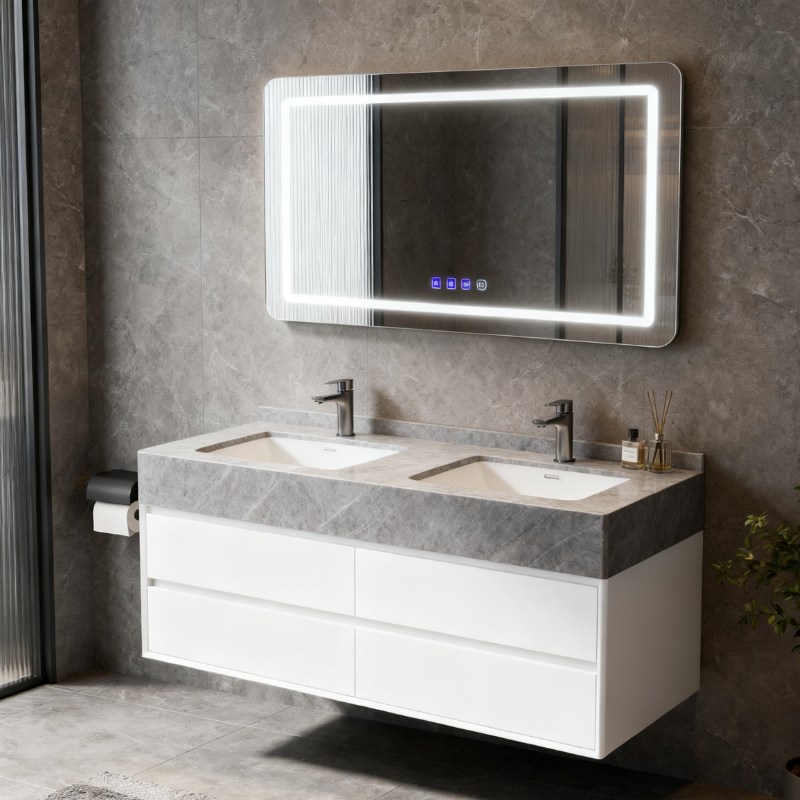
Smart Bathroom Vanities: Redefining Modern Bathroom Furniture & Market Opportunities
Published: May 12, 2026
▼ Table of Contents (Click to expand)
‑ Article Introduction ‑ 1. Are smart bathroom vanities poised for mainstream adoption? ‑ 2. What exactly is a smart bathroom vanity system? ‑ 3. Core functional modules of smart bathroom vanities ‑ 3.1 Multi‑scene smart lighting ‑ 3.2 Anti‑fog mirror technology ‑ 3.3 Built‑in power outlets and charging interfaces ‑ 3.4 Touch and sensor‑driven interactive controls ‑ 3.5 Intelligence‑oriented optimized storage ‑ 3.6 Wellness‑focused personalised functional features ‑ 4. Key market drivers behind rising smart‑vanity demand ‑ 5. Real‑world benefits for end‑users and commercial project clients ‑ 5.1 Advantages for residential end‑consumers ‑ 5.2 Advantages for hotels, developers and project stakeholders ‑ 6. Smart bathroom vanity VS traditional vanity: core conceptual differences ‑ 7. Smart Vanity vs Traditional Vanity Full Comparison Table ‑ 8. Best‑fit application scenarios for smart bathroom vanity solutions ‑ 8.1 Master / primary residential bathrooms ‑ 8.2 Mid‑to‑high‑end home renovation projects ‑ 8.3 Boutique hotels and serviced apartment developments ‑ 8.4 Compact bathrooms requiring high‑density storage ‑ 8.5 Age‑friendly and multi‑generational households ‑ 8.6 Beauty‑focused users pursuing premium daily ritual experience ‑ 9. Future‑facing market shifts and product design trends ‑ 9.1 Macro market development trends ‑ 9.2 Product‑level design evolution directions ‑ 10. Strategic preparations for B2B importers, wholesalers and purchasers ‑ 10.1 Build tiered “light‑smart‑first” product portfolios ‑ 10.2 Establish stable supply‑chain for mirror‑cabinet electrical modules ‑ 10.3 Prioritise moisture resistance, electrical safety and maintainability ‑ 10.4 Pre‑emptively research target‑market certification and regulatory rules ‑ 10.5 Shift from selling discrete SKUs toward selling complete scenario‑based solutions ‑ 10.6 Conduct pre‑sales education for sales channels and partners ‑ 10.7 Build data‑driven product‑selection and feedback mechanisms ‑ 10.8 Develop replicable, standardised product series ‑ 10.9 Capture market gap: light‑luxury, practicality and service‑friendliness ‑ 10.10 Construct cross‑functional comprehensive evaluation capabilities ‑ 11. Immediate actionable steps for B2B procurement teams ‑ 12. Expert practical recommendations for B2B buyers ‑ 13. Final Conclusion
Article IntroductionThe future of bathroom furniture will not merely be “vanities with built‑in lights”. It lies in complete integrated smart vanity ecosystems that unify cabinets, mirror cabinets, lighting hardware, power supply modules, sensor interaction and organised storage. Driven by home‑renovation upgrades and smart‑home penetration, consumers now purchase bathroom furniture for improved daily experience rather than basic storage alone. This article unpacks core functions, applicable scenarios, market trends and critical B2B sourcing advice for smart bathroom vanities, serving residential buyers, retailers, importers, hotel developers and interior‑design stakeholders.
1. Are smart bathroom vanities poised for mainstream adoption?
The answer is affirmative, but growth will follow a gradual penetration trajectory, rather than rapid full replacement of conventional bathroom vanities.
Smart vanities will not completely displace traditional cabinet products overnight, but gain steady traction within these segments:
Mid‑to‑high‑end residential renovation markets
Boutique serviced apartments and upgrade‑focused housing developments
Hotel, wellness‑oriented commercial projects
Young‑family and high‑disposable‑income consumer groups
End‑users prioritising lighting quality, anti‑fog performance, convenient charging and tidy storage experience
Today’s consumers no longer only buy a cabinet for holding wash‑basin articles. They invest in better morning grooming routines, high‑quality task lighting, clutter‑free countertops and an elevated spatial atmosphere.
NKBA 2026 bathroom‑industry trend research points out that smart‑home integration, wellness‑driven design, ageing‑in‑place adaptation and personalised organisation are fast‑growing bathroom priorities. Houzz 2025 renovation surveys also indicate upgraded medicine mirror cabinets are evolving past simple storage toward integrated outlets, anti‑fog systems and multi‑mode illumination.
To be precise, the rising market is not isolated “smart cabinet hardware”. The real growth vector is:
Smart Bathroom Vanity System = Base vanity cabinet + smart mirror / mirror cabinet + multi‑mode lighting + power & charging modules + sensor interaction + optimised organised storage
2. What exactly is a smart bathroom vanity system?
A smart bathroom vanity builds upon traditional vanity furniture and adds integrated electronic modules plus human‑centred interaction logic.
It is not merely a wooden cabinet plus a lit mirror. A complete system commonly comprises: ‑ Main vanity cabinet / drawer base unit and sink assembly ‑ Smart mirror or functional mirror cabinet ‑ Integrated adjustable LED lighting system ‑ Anti‑fog heating film module ‑ Concealed outlets, USB‑A / Type‑C charging ports ‑ Touch‑control or proximity‑sensor interactive interfaces ‑ Optimised smart storage partitions ‑ Soft night‑time ambient guide lighting ‑ Optional time / temperature / humidity digital display ‑ Higher‑end configurations may add Bluetooth audio, voice‑control or wellness‑related monitoring modules
In short: smart bathroom vanities merge furniture aesthetics, storage capacity, electrical convenience and digital interaction into one unified bathroom scenario solution.
3. Core functional modules of smart bathroom vanities
3.1 Multi‑scene smart lighting
Smart lighting ranks among the most practical and market‑accepted smart‑vanity features. Typical implementations include perimeter mirror lighting, back‑lit indirect lighting, stepless brightness adjustment, colour‑temperature switching (warm‑neutral‑cool white), scene presets and low‑brightness night guide‑lights.
Bathrooms impose high requirements on task lighting for makeup, shaving and skincare. NKBA industry statistics show more than 90 % of bathroom design professionals identify high‑quality vanity lighting as a core priority for primary bathrooms.
3.2 Anti‑fog mirror technology
Mirror anti‑fog delivers highly perceptible user‑experience improvement. Following hot‑shower steam buildup, anti‑fog heating films prevent mirror‑surface condensation, so users can use mirrors immediately without waiting for natural defogging. This feature has become standard on many upgraded mirror‑cabinet product lines according to Houzz market observations.
3.3 Built‑in power outlets and charging interfaces
Concealed inside mirror cabinets or vanity drawers: shaver sockets, hair‑dryer dedicated outlets, USB‑C charging ports. These modules resolve messy countertop wiring caused by beauty devices, electric toothbrushes and personal electronics, keeping counter‑surfaces neat and tidy. Hidden power interfaces represent one of consumers’ most‑wanted upgrade functions.
3.4 Touch and sensor‑driven interactive controls
Common implementations: touch buttons for light / anti‑fog switching, wave‑activated proximity sensors, door‑triggered interior lighting that turns on when cabinet doors open, drawer‑linked illumination. These features do not rely on complex high‑tech chips, yet significantly upgrade product premium‑grade tactile‑experience.
3.5 Intelligence‑oriented optimised storage
“Smart” does not equal electronics only. Modern smart‑vanity design also emphasises human‑centric storage architecture: dedicated hair‑tool compartments, cosmetic divider trays, medicine storage zones, appliance‑charging dedicated cavities and adjustable movable drawer partitions. NKBA trend reports note custom configurable storage modules are accelerating in real‑world adoption.
3.6 Wellness‑focused personalised functional features
Higher‑end product lines may integrate time‑temperature‑humidity readouts, Bluetooth audio playback, voice‑control modules, senior‑friendly accessible operating logic and mood‑based ambient‑lighting presets. Although these features are not yet mass‑market mainstream, they mark the long‑term product‑evolution direction toward wellness‑centred bathroom spaces.
4. Key market drivers behind rising smart‑vanity demand
Fully‑loaded flagship smart vanities are still niche‑volume goods, yet supporting modules (smart mirror cabinets, anti‑fog films, integrated lighting, hidden power sockets and refined storage organisation) are seeing rapid market penetration. Four major driving forces:
Consumer‑grade renovation upgrading: Home‑buyers shift demand from “merely functional” toward easy‑to‑maintain, convenient and aesthetic‑premium living environments.
Smart‑home ecosystem popularisation: Users already utilise smart lighting, smart locks and smart speakers; bathrooms naturally follow this home‑upgrade wave.
Growing wellness‑consciousness: Bathrooms transform from simple washing‑spaces to self‑care, relaxation and grooming ritual zones.
Mature component supply‑chain: LED strips, anti‑fog films, touch‑sensor controllers and modular mirror‑cabinet assemblies continuously decrease in cost, lowering market‑access thresholds.
Hotel and high‑end residential projects demonstrate product value first, then features gradually filter down to mid‑market retail channels.
5. Real‑world benefits for end‑users and commercial project clients
5.1 Advantages for residential end‑consumers
‑ Higher daily‑use convenience: lighting, anti‑fog and charging functions remove many small‑scale bathroom frustrations ‑ More organised storage: purpose‑built dividers reduce internal clutter ‑ Cleaner countertop visual effect: hidden wiring and concealed power modules eliminate messy adapters ‑ Elevated interior aesthetic: integrated mirror‑lighting improves modern‑style bathroom ambiance ‑ Better human‑centred experience: night‑lights, high‑CRI grooming lighting enhance comfort for all‑age household‑members ‑ Forward‑compatible with modern smart‑home renovation trends
5.2 Advantages for hotels, developers and project stakeholders
‑ Creates project‑level selling‑point premium: smart‑feature sets serve as differentiating marketing content for apartments and hospitality properties ‑ Stronger product differentiation within highly‑homogenised bathroom‑fixture markets ‑ Improves end‑user satisfaction: anti‑fog mirrors, good lighting and convenient charging are immediately perceptible guest‑benefits ‑ Supports high‑end project positioning: well‑suited for boutique hotels, serviced apartments and luxury residential developments
6. Smart bathroom vanity VS traditional vanity: core conceptual differences
Traditional bathroom vanities focus on three core deliverables: basic storage, sink‑bearing structure and decorative appearance at controlled acquisition‑cost.
Smart bathroom vanity systems expand value proposition to: storage capacity + lighting performance + anti‑fog capability + power convenience + sensor‑interaction + scenario‑oriented user‑experience.
They are not simple substitute‑versus‑substitute rivalry. Instead they target distinct consumer tiers and requirement sets.
Traditional vanities sell you the furniture cabinet itself. Smart bathroom vanities sell you the complete bathroom‑usage experience.
7. Smart Vanity vs Traditional Vanity Full Comparison Table
Evaluation Dimension | Smart Bathroom Vanity System | Conventional Traditional Vanity |
|---|---|---|
Core positioning | Complete bathroom scenario‑experience system | Basic functional bathroom furniture |
Primary functions | Storage + lighting + anti‑fog + charging + sensor interaction + organised storage | Storage + sink‑support + decoration |
Mirror performance | Built‑in lighting, anti‑fog, touch‑interaction | Plain ordinary mirror or no matching mirror |
Power integration | Concealed outlets / USB‑C charging ports | No built‑in power‑related components |
Storage architecture | Customisable dividers and classified compartments | Basic drawers and swing‑door cabinets |
Visual neatness | High; hides wires and adapters | Countertop easily becomes cluttered with adapters |
Perceived premium texture | Strong | Determined purely by material and finish |
Initial procurement expense | Higher | Lower |
Installation complexity | Higher: requires pre‑planning wiring, moisture‑proofing and electrical safety | Simple, minimal pre‑requisites |
Maintenance burden | Moderate; contains replaceable electronic modules | Low, furniture‑only maintenance |
Target‑customer groups | Mid‑high‑end renovation, hotel‑apartment projects, experience‑oriented consumers | Budget‑focused buyers, basic residential projects |
Product differentiation potential | Very strong | Limited, subject to commodity‑style price competition |
Profit‑margin potential for channels | Higher | Price transparency compresses profit space |
Future‑trend adaptability | High | Medium‑to‑low |
8. Best‑fit application scenarios for smart bathroom vanity solutions
Smart vanities are not universally required for every bathroom. These scenarios realise maximum value:
8.1 Master / primary residential bathrooms
Homeowners spend significant daily time in master bathrooms; they place higher expectations for mirror lighting, storage organisation and comfort. This represents the largest‑volume applicable residential scenario.
8.2 Mid‑to‑high‑end home renovation projects
These customers are not satisfied with merely replacing old cabinets; they pursue holistic bathroom‑experience upgrades.
8.3 Boutique hotels and serviced apartment developments
Hospitality projects prioritise guest‑experience highlights. Smart vanity functions deliver memorable premium perception without massive construction modification.
8.4 Compact bathrooms requiring high‑density storage
Small‑sized bathrooms benefit greatly from integrated mirror‑cabinet storage, hidden charging ports and multi‑functional lighting to maximise limited spatial resources.
8.5 Age‑friendly and multi‑generational households
Night‑time sensor‑activated guide‑lights, high‑quality task‑lighting and simple‑to‑operate touch interfaces improve safety and usability for elderly household‑members, matching rising ageing‑in‑place design‑trends.
8.6 Beauty‑focused users pursuing premium daily ritual experience
Consumers engaged in skincare and makeup attach great importance to accurate mirror lighting, tidy storage and convenient device‑charging.
9. Future‑facing market shifts and product design trends
9.1 Macro market development trends
Progressive modular adoption: Consumers rarely purchase fully‑featured flagship units in one step. Market evolution proceeds light‑smart → mid‑smart → full‑smart. LED lighting, anti‑fog and concealed charging will become mainstream optional modules first.
Wellness‑oriented function iteration: Technology exists to serve comfort and daily self‑care rather than pursue meaningless tech gimmicks.
Mid‑to‑high‑end markets lead adoption: Upgrading residential renovation, boutique hospitality and real‑estate projects are the primary early‑adopter segments.
Maintainability becomes critical buying‑criterion: Market demands products easy‑to‑clean, easy‑install, low‑failure‑rate and with accessible spare‑parts.
Invisible intelligence trend: Premium smart‑vanity design conceals electronic hardware. Appearance leans toward minimalist, wood‑tone and natural‑texture aesthetics instead of obvious “tech‑looking” styling.
9.2 Product‑level design evolution directions
Prioritise light‑smart practical functions: Stepless dimming, adjustable colour‑temperature, anti‑fog film, night‑guide‑lights, cabinet‑door‑triggered interior lighting; over‑complex voice‑control and display‑screen features remain niche.
Mirror‑cabinet‑centric integration: Most smart‑functions will be integrated within mirror‑cabinets instead of main cabinet bodies. Mirrors naturally host lighting, anti‑fog, touch‑controls and power modules.
Modular storage architecture: Move past large empty drawers toward purpose‑specific compartments for beauty‑tools, appliances and medications.
Enhanced moisture‑proofing and electrical safety: Humid bathroom setting imposes strict requirements for IP‑rated sealing, isolated power‑drivers, wiring‑protection and replaceable modular electronics.
Seamless low‑friction interaction: Proximity‑sensing, memory‑scene presets; operations remain intuitive without complicated learning‑curves.
Age‑friendly inclusive design: Accessible illumination and simple controls serve multi‑generational households.
Aesthetic return to natural minimalism: Wood‑grain finishes, matte surfaces, handle‑less concealed hardware dominate visual‑design directions.
10. Strategic preparations for B2B importers, wholesalers and purchasers
Smart bathroom vanities should be treated as a multi‑year product‑upgrade track, not one‑off individual SKU procurement. Competitive players build product portfolios, supply‑chain resources, certification compliance, after‑sales‑service capacity and scenario‑solution capabilities in advance.
10.1 Build tiered “light‑smart‑first” product portfolios
Construct three‑tier product matrix to balance volume, profit and market‑testing risks: ‑ Entry‑level Light‑Smart: LED lighting, anti‑fog film, touch‑switch, basic mirror‑cabinet storage. ‑ Mid‑range Core‑selling: Adjustable colour‑temperature & dimming, hidden charging‑ports, door‑activated inner‑lighting, night‑light, configurable drawer‑dividers. ‑ High‑end Flagship: Bluetooth audio, time‑temperature‑display, advanced‑sensor interaction, complete system‑package combinations.
Benefits: possess volume‑driving SKUs, high‑margin flagship display‑models, room for market trial‑and‑error without excessive upfront cost and after‑sales pressure from over‑complicated functions.
10.2 Establish stable supply‑chain for mirror‑cabinet electrical modules
Core competitiveness no longer depends purely upon wooden‑cabinet manufacturing. It lies in reliable integration of LED‑drivers, anti‑fog films, touch‑sensor assemblies, power‑outlet modules, USB‑C interfaces, wiring harnesses and waterproof connectors. Prioritise suppliers who can deliver stable, maintainable, certified electronic sub‑assemblies.
10.3 Prioritise moisture resistance, electrical safety and maintainability
Many smart‑product failures do not stem from poor‑looking design, but humid‑environment‑induced electronic‑faults, wiring‑damage and difficult‑repairs. When sourcing, strictly audit: electronic‑component lifespan, moisture‑isolated structural‑design, electrical‑safety certification standards, driver stability, modular replaceability and completeness of installation manuals.
10.4 Pre‑emptively research target‑market certification and regulatory rules
Different territories impose distinct requirements for electrical components integrated into bathroom furniture: ‑ North‑America market: UL / ETL certification for lighting and power modules, CARB Phase 2 for wood‑based substrates. ‑ European market: CE marking complying with LVD and EMC directives, IP‑protection ratings for bathroom‑zone electronics.
Certification compliance must be considered during early‑sample‑development instead of after mass‑production finishes.
10.5 Shift from selling discrete SKUs toward selling complete scenario‑based solutions
Future winning wholesalers and retailers sell solution bundles instead of isolated single cabinets: ‑ 36‑inch floating vanity + smart mirror cabinet + side‑storage cabinet home‑renovation set ‑ Compact‑apartment smart vanity package ‑ Master‑bathroom wellness‑oriented combination ‑ Age‑friendly multi‑generational bathroom solution
Upgrade business‑mindset from “selling cabinets” to “delivering bathroom‑space‑solutions”.
10.6 Conduct pre‑sales education for sales channels and partners
Smart vanities require market education. Prepare showroom demo‑samples, function‑comparison videos, installation‑guidance materials, FAQ documents, training kits for retail staff and specification reference‑files for interior‑designers and contractors. Most customers form purchase‑intent after seeing real‑function demonstrations.
10.7 Build data‑driven product‑selection and feedback mechanisms
Track actionable market‑feedback: inquiry rates for each function, return‑rate statistics, suitable‑size ranges for smart configurations, channel‑level acceptance for premium‑priced features, functions that look impressive yet generate few real‑orders. More functions do not automatically equal better sales; correct function‑mix matters more.
10.8 Develop replicable, standardised product series
Full custom‑built smart‑products create exploding lead‑time, cost and after‑sales risks. Define fixed standard‑sizes, limited function‑option‑packages, unified styling‑families, consistent electrical‑interfaces and validated export‑grade packaging, enabling scalable volume‑business.
10.9 Capture market gap: light‑luxury, practicality and service‑friendliness
Largest market opportunity lies in products balancing premium appearance, moderate practical‑feature‑sets, easy‑installation, low‑failure‑rate and acceptable price‑points. These perform best for both retail‑channels and wholesale‑project‑business.
10.10 Construct cross‑functional comprehensive evaluation capabilities
Sourcing smart vanities demands combined competence covering furniture‑manufacturing, electronic‑modules, packaging‑engineering, compliance‑certification and after‑sales‑support. Build evaluation checklists for cabinet‑quality, electronic‑integration, QC‑process, installation‑documentation, drop‑tested‑packaging and after‑sales‑response workflows.
11. Immediate actionable steps for B2B procurement teams
‑ Segment your product lineup: basic traditional models, light‑smart mainstream, high‑end smart flagship ‑ Rank‑order feature priority: priority list: anti‑fog, adjustable lighting, charging‑ports, organised storage; secondary: Bluetooth, screen‑displays, voice‑control ‑ Build competitor‑reference library: collect specs and samples from mainstream e‑commerce and bathroom‑specialty‑brands ‑ Execute sample validation: high‑humidity endurance testing, LED‑lifespan, anti‑fog‑effect, switch‑reliability, transport‑shock‑test packaging assessment ‑ Grade your supplier‑base: separate suppliers strong at cabinet‑making, mirror‑cabinet‑assembly, electronic‑modules and full‑system integration; avoid expecting one‑supplier to excel at everything ‑ Pilot‑launch through limited‑scale channels and model‑room‑projects before full‑roll‑out across all sales‑networks ‑ Design after‑sales framework in advance: define spare‑parts inventory list, common‑failure‑components, remote‑troubleshooting‑guides and installation‑training‑material.
12. Expert practical recommendations for B2B buyers
Suggestion 1: Do‑not‑confuse smart‑upgrade with “adding as many complex features as possible”.Products with intuitive‑to‑understand, stable and install‑friendly functions consistently outperform gimmick‑heavy flagship‑units.
Suggestion 2: Prioritise functions delivering instantly‑perceivable end‑user‑value.Top‑value‑features: adjustable vanity‑lighting, anti‑fog mirror, built‑in charging‑interfaces, organised storage compartments and night‑guide‑lights.
Suggestion 3: Start‑product‑development work from mirror‑cabinet systems.Mirror cabinets naturally accommodate lighting, anti‑fog, touch‑controls and power‑modules, making them better smart‑feature carriers than base vanity‑cabinet carcasses.
Suggestion 4: Pay extra attention to packaging quality.Smart vanities integrate glass‑mirrors, delicate LED‑components and wiring harnesses. Upgrade foam, corner‑protection and outer‑carton construction to mitigate ocean‑shipping transit‑damage.
Suggestion 5: After‑sales‑support capability equals core‑competitiveness.In smart‑product competition, product‑design is only half‑the‑battle; long‑term reliability and accessible spare‑part‑support determine brand‑reputation.
Suggestion 6: Establish early‑stage communication with developers, hotel‑operators and interior‑design‑partners.Many smart‑vanity specification‑decisions are made in early‑design‑phases of renovation‑projects, not at final‑procurement‑time.
13. Final Conclusion
Smart bathroom vanities will gain expanding market share, but mass‑market‑success belongs to practical light‑smart integrated‑solutions instead of over‑engineered tech‑gimmick‑oriented goods.
The clearest future‑market directions are: high‑quality adjustable vanity‑lighting, reliable anti‑fog‑mirror performance, convenient concealed‑charging, classified‑organised‑storage, minimalist natural‑looking styling, ageing‑friendly usability, plus strict attention to installation simplicity and long‑term‑product‑reliability.
For B2B importers, wholesalers and purchasers: instead of passively waiting for market maturity, take three proactive‑steps right‑now:
Develop tiered light‑smart product portfolios ahead‑of‑curve.
Build mirror‑cabinet electronic‑module supply‑chains and market‑specific compliance‑certification‑readiness.
Evolve business‑thinking: shift from “selling cabinets” toward “delivering complete bathroom‑scenario‑solutions”.
Players accomplishing these three steps will capture the biggest market opportunities within the next several‑years of bathroom‑furniture‑industry evolution, as indicated by NKBA, Houzz and global bathroom‑industry‑market‑research‑data.