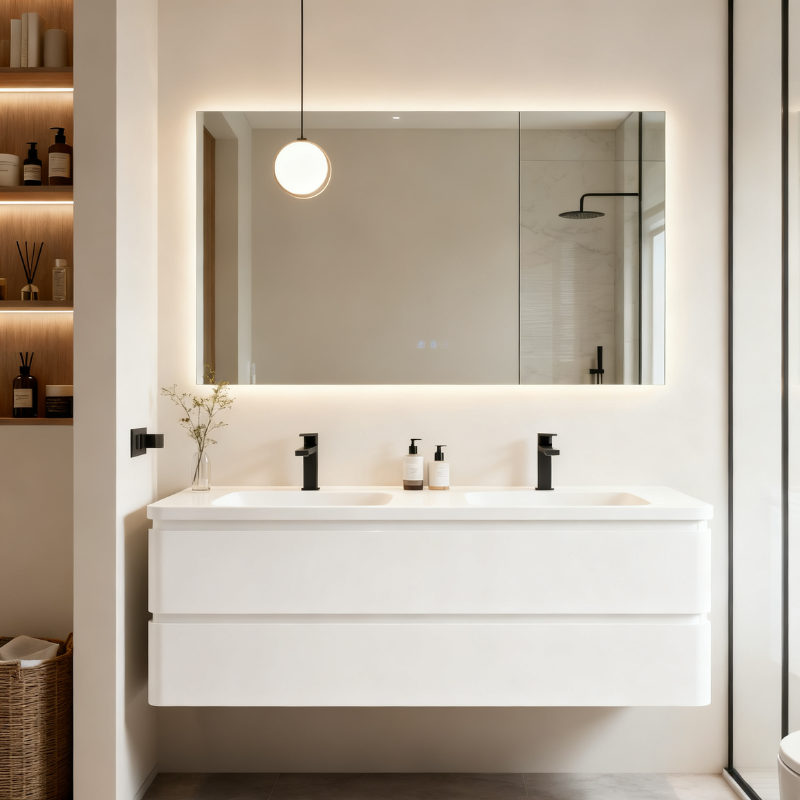
Bathroom Vanity Terminology Handbook: Complete Glossary for Buyers, Importers and Interior Designers
Published: April 28, 2026
▼ Table of Contents (Click to expand)
‑ Article Introduction ‑ 1. Core Basic Terms for Bathroom Vanities ‑ 2. Full Breakdown of Vanity Component Knowledge ‑ 2.1 Cabinet Carcass Structure ‑ 2.2 Countertop Assembly ‑ 2.3 Basin & Sink Components ‑ 2.4 Full Hardware System ‑ 2.5 Storage Layout Classification ‑ 2.6 Installation‑Related Parts ‑ 3. Main Classification Systems of Bathroom Vanities ‑ 3.1 Classified by Number of Sinks ‑ 3.2 Classified by Installation Method ‑ 3.3 Classified by Main Storage Form ‑ 3.4 Classified by Interior Design Style ‑ 3.5 Classified by Production & Assembly Mode ‑ 4. Different Basin / Sink Types Explained ‑ 5. Cabinet Substrate Materials: Pros, Cons & Application Scenarios ‑ 6. Common Surface Finish Options for Vanity Cabinets ‑ 7. Complete Hardware Glossary for Bathroom Vanities ‑ 8. Countertop Material Comparison Guide ‑ 9. Critical Plumbing & Installation‑Related Terms Explained ‑ 10. Frequently Asked Practical Buying Questions ‑ 11. Practical Sourcing Tips From Vanity Manufacturers ‑ 12. Quick Reference Comparison Summary Table ‑ 13. Final Conclusion
Article IntroductionWhen purchasing, quoting or specifying bathroom vanities, you will encounter large volumes of industry‑specific jargon. Misunderstanding these terms may result in wrong product selection, inconsistent sample expectations, installation errors and costly after‑sales disputes. This handbook compiles core terminology for bathroom vanities, covering components, classifications, materials, hardware, plumbing and real‑world buying advice. This reference is suitable for residential end‑users, retail buyers, importers, project contractors and interior designers to communicate accurately with factories and installation teams.
1. Core Basic Terms for Bathroom Vanities
Term | Definition & Practical Explanation |
|---|---|
Bathroom Vanity | Complete integrated unit including cabinet carcass, countertop, sink and bathroom storage space; widely‑used term across North‑American markets |
Vanity Cabinet | Only the cabinet box / carcass part, excludes countertop and sink |
Vanity Unit | Common expression in Europe, Australia; refers to full complete vanity set |
Bathroom Cabinet | Broader category; may include mirror cabinets, tall linen cabinets besides the sink base cabinet |
Washstand | Decorative, traditional‑style wording for basin furniture |
Carcass / Cabinet Body | Main load‑bearing cabinet framework: side panels, bottom panel, rear back panel, cross rails, divider panels. Directly decides cabinet strength, moisture‑resistance and service lifespan |
Countertop | Horizontal top surface sitting above cabinet, holds sink, faucet and daily toiletries |
Basin / Sink | Washing bowl component; "basin" and "sink" are interchangeable within bathroom industry vocabulary |
Faucet Hole | Pre‑drilled openings on countertop or sink for faucet mounting: single‑hole, 4‑inch centerset, 8‑inch widespread. Wall‑mount faucets require no countertop holes |
Overflow Hole | Auxiliary opening on inner sink wall to prevent water overflow. Many vessel sinks and sintered‑stone basins do not feature overflow holes |
Drain Hole | Opening at basin bottom for pop‑up drain assembly installation |
P‑Trap | U‑shaped drain pipe, North‑American mainstream fitting, blocks sewer odour back‑flow |
Bottle Trap | Compact‑profile trap, widely used for floating vanities with wall‑drain plumbing layout |
Soft‑Close | Damping buffer mechanism built into hinges and drawer slides, enabling slow, quiet closing without slamming impact noise |
Wall‑Mounted / Floating Vanity | Cabinet fully hung onto wall surface, zero floor contact; delivers light visual effect and easier floor cleaning, yet demands high wall load‑bearing capacity |
Freestanding Vanity | Cabinet stands fully upon finished floor surface; lower requirement for wall strength, normally provides larger total storage capacity |
Toe Kick | Recessed bottom section on freestanding vanities; creates foot clearance when users stand close against cabinet, conceals base structural components |
Filler Strip | Decorative trim piece used to fill narrow gaps between vanity cabinet and uneven walls, frequently used for custom‑fit renovation projects |
Backsplash | Vertical strip fitted behind countertop against wall, prevents water splashing onto painted wall or tile surfaces |
Side Splash | Short splash piece installed on countertop side edge where cabinet meets side wall |
2. Full Breakdown of Vanity Component Knowledge
A complete bathroom vanity works as a systematic product instead of simple cabinet plus sink assembly. Every module influences end‑user experience, long‑term durability and final installation result.
2.1 Cabinet Carcass Structure
Component | Core Function |
|---|---|
Left & Right Side Panels | Main vertical cabinet supports, critical for screw‑holding performance and anti‑swelling properties |
Bottom Panel | Bears internal storage weight and supports whole cabinet assembly |
Top Cross Rail | Reinforces upper cabinet frame, disperses countertop weight load |
Back Panel | Rear bracing component; may reserve pre‑cut openings for plumbing to pass through |
Middle Divider | Separates internal cabinet space for double‑sink or multi‑compartment layouts |
Adjustable Shelf | Adds extra horizontal storage layers inside cabinet |
Door Panel | Swing‑open exterior panel for cabinet storage compartments |
Drawer Front | Decorative front face of drawer assembly |
Drawer Box | Actual drawer storage‑box structure, including side, rear and bottom panels |
Cabinet Leg / Base | Supporting elements for freestanding vanity units |
2.2 Countertop Assembly
The countertop bears sink weight, water splashes, cosmetic and hair‑dye spills. Key performance requirements: water‑resistance, stain‑resistance, scratch‑resistance, load‑bearing capacity and precisely‑processed cut‑outs for sink and faucet hardware.
2.3 Basin & Sink Components
Key evaluation points: basin depth, internal dimension, overflow‑hole setting, drain‑hole location, faucet‑opening layout, sealing joint quality between sink and countertop.
2.4 Full Hardware System
Hardware largely defines daily operating experience of vanities. Includes hinges, drawer slides, handles, wall‑mount brackets, adjustable feet, shelf supports, cam‑lock connectors and complete drain‑trap assemblies. Poor‑grade hardware creates most after‑sales complaints even with good‑looking cabinet appearance.
2.5 Storage Layout Classification
Common storage structures: swing‑door cabinet storage, standard drawers, U‑shaped plumbing‑avoidance drawers, open shelving, internal divider systems, coordinating side cabinets and tall linen cabinets. High‑quality storage design classifies cosmetics, hairdryers, bottles and towels reasonably.
2.6 Installation‑Related Parts
Especially important for floating wall‑hung vanities: heavy‑duty wall brackets, reinforced rear mounting board, expansion anchor bolts, levelling feet, anti‑tip fittings and pre‑cut plumbing relief openings.
3. Main Classification Systems of Bathroom Vanities
3.1 Classified by Number of Sinks
Single‑Sink Vanity
Suited for guest bathrooms, powder rooms, apartments and single‑user households. Common sizes: 24",30",36",48". ‑ Advantages: compact footprint, cost‑effective, abundant product selections ‑ Disadvantages: cannot support simultaneous dual‑person usage, limited counter workspace
Double‑Sink Vanity
Suited for master bathrooms, hotel suites and multi‑member‑family scenarios. Common sizes:60",72",84",96". ‑ Advantages: enables parallel usage, premium visual effect ‑ Disadvantages: occupies larger bathroom footprint, higher total cost, more complex plumbing requirements
3.2 Classified by Installation Method
Freestanding Vanity‑ Pros: high stability, simple installation, low wall‑strength demand, generous storage volume ‑ Cons: Harder‑to‑clean floor underneath; floor moisture may shorten cabinet service‑life
Floating / Wall‑Mounted Vanity‑ Pros: modern minimalist aesthetic, easy‑to‑mop floor surface, visually enlarges compact‑sized bathrooms, adjustable installation height ‑ Cons: strict wall‑structure load‑bearing requirements; plumbing needs advance planning; higher manufacturing & installation cost
Corner VanityInstalled inside bathroom corner to utilise dead‑space, fits compact powder‑rooms. ‑ Pros: maximises limited bathroom floor area ‑ Cons: relatively limited storage capacity, fewer design alternatives
3.3 Classified by Main Storage Form
Door‑Based Vanity: Mainly swing cabinet doors. Large inner‑space for bulky articles; drawback: small‑item organisation tends to become messy.
Drawer‑Based Vanity: Drawers act as primary storage. Convenient access to daily goods; demands higher‑quality slide hardware and plumbing‑avoidance design.
Door + Drawer Combined Vanity: Mixed layout balancing both storage forms; the most practical household‑oriented option.
3.4 Classified by Interior Design Style
‑ Modern Vanity: Clean straight‑line door panels, handle‑less solutions, matte finishes; mainstream colours: white, grey, wood‑tone, black ‑ Traditional Vanity: Shaker‑style doors, rich decorative moulding, classic retro colour palette ‑ Luxury High‑End Vanity: Premium stone countertops, metallic accents, high‑grade hardware, bespoke customised detailing ‑ Minimalist Vanity: Flat plain surfaces, concealed‑handle design, neutral‑colour palette, focus on spatial simplicity
3.5 Classified by Production & Assembly Mode
‑ RTA (Ready‑to‑Assemble) Vanity: Flat‑packed, end‑user completes on‑site assembly. Lower ocean‑shipping expense, compact carton packaging, widely‑used for e‑commerce. Risk: final quality heavily depends on assembly workmanship. ‑ Pre‑Assembled Vanity: Factory fully assembled before shipment. Better structural integrity, fewer after‑sales‑issues, but larger‑package volume and higher transit‑damage risk. ‑ Modular Vanity: Assembled from multiple standard functional modules. Well‑suited for hotel, real‑estate‑project and semi‑custom retail product‑lines.
4. Different Basin / Sink Types Explained
Vessel Sink: Sink sits fully above countertop. Strong decorative visual impact; downside: easy water‑splashing, requires taller faucet specification.
Undermount Sink: Mounted underneath countertop bottom. Countertop surface can wipe residues directly into sink bowl, delivering excellent easy‑clean performance; demands precise countertop cutting and solid supporting‑structure.
Drop‑in Sink: Sink rim rests upon countertop cut‑out. Simple installation, moderate cost; rim gap accumulates dirt gradually with time.
Integrated Sink: Sink and countertop manufactured as one‑piece seamless unit. Outstanding waterproof‑performance, easy maintenance; repair difficulty increases upon damage.
Semi‑Recessed Sink: Sink partially inserts into cabinet front‑edge. Space‑saving, comfortable user‑height; requires precise cabinet dimension‑design.
Wall‑Mount Sink: Sink fixed directly onto wall without cabinet underneath. Maximises bathroom‑floor‑space; almost zero storage capacity underneath.
5. Cabinet Substrate Materials: Pros, Cons & Application Scenarios
Bathrooms operate in high‑humidity environments, so substrate moisture‑resistance, dimensional‑stability and screw‑holding‑capability represent core evaluation indicators.
Material | Advantages | Potential Drawbacks | Best Application Scenarios |
|---|---|---|---|
MDF (Medium‑Density Fiberboard) | Ultra‑smooth surface, ideal for painting / PET wrapping, moderate‑cost | Ordinary MDF swells easily once water invades cut‑edges; must adopt moisture‑resistant grade plus complete edge‑banding | Cabinet door / drawer‑front panels for mid‑range vanities |
Plywood | High structural‑strength, excellent screw‑holding‑performance, better moisture‑resistance compared with MDF / particle‑board | Surface smoothness inferior to MDF, higher unit‑price | Floating vanities, hotel‑project cabinets, high‑humidity‑bathroom‑environments |
Particle Board | Low‑cost, good dimensional‑stability under dry‑state, compatible with melamine finish | Weak screw‑retention; edges swell rapidly upon water‑contact | Budget‑level vanities for well‑ventilated dry‑bathrooms |
Solid Wood | Natural wood‑grain texture, premium visual‑quality | Vulnerable to humidity‑caused warping & cracking, high‑price | Luxury custom high‑end residential‑projects; demands full‑sealing finishing |
PVC Foam Board | Fully‑waterproof, anti‑mould, light‑weight | Relatively weak screw‑holding‑strength, less‑premium‑texture | High‑moisture budget‑oriented‑bathroom‑products |
Stainless Steel | Waterproof, corrosion‑resistant, easy‑to‑wipe‑clean | Cold‑industrial‑visual‑feeling, fingerprint‑prone surface | Commercial, public‑area‑bathroom‑projects |
Aluminium Alloy | Rust‑proof, light‑weight, dimensionally‑stable | Limited wood‑like decorative‑effect | Special‑style waterproof‑cabinet‑lines |
Manufacturer Tip: Material performance depends not only upon board‑type itself, but also edge‑banding‑quality and sealing‑treatment of drilling and cutting openings.
6. Common Surface Finish Options for Vanity Cabinets
Finish Type | Characteristics | Practical Notes |
|---|---|---|
Painted Finish | Rich colour‑choices, smooth premium‑looking‑surface | Vulnerable to hard‑object‑impact; paint‑thickness and primer‑quality decide durability |
Melamine Finish | Cost‑effective, scratch‑resistant, abundant‑pattern‑alternatives | Edge‑banding‑quality is critical for bathroom‑usage |
Laminate | Good wear‑resistance, stain‑resistant | Limited capability for complex curved door‑shaping |
PVC Thermofoil | Can wrap contoured‑shaped‑doors, seamless‑wrapping‑effect | Risk‑of‑peeling under sustained‑high‑temperature‑environment |
Wood Veneer | Real‑natural‑wood‑grain, high‑grade‑texture | Must implement complete‑sealing‑treatment to resist‑bathroom‑humidity |
PET Finish | Smooth‑surface, stable‑colour‑performance, anti‑fingerprint | Widely‑applied within modern‑style mid‑high‑grade‑cabinets |
Lacquer Finish | Glossy‑luxurious‑appearance | Higher‑production‑cost, strict‑workshop‑environmental‑requirements |
7. Complete Hardware Glossary for Bathroom Vanities
‑ Hinges: Concealed soft‑close clip‑on hinges are mainstream for bathroom cabinets. Evaluate corrosion‑resistance grade, opening‑angle and operating smoothness. ‑ Drawer Slides: Side‑mount slides, undermount concealed slides. Key parameters: load‑rating, full‑extension / partial‑extension, soft‑close / push‑open function, anti‑rust‑treatment. Wide drawers require heavy‑load‑grade slides. ‑ Handles & Pulls: Bar pull, knob, edge‑pull, recessed‑handle, handle‑less magnetic‑catch. Material options: zinc‑alloy, stainless‑steel, aluminium, brass. ‑ Wall‑Mount Brackets: Core hardware for floating‑vanities; must match total‑weight of cabinet including countertop and sink. ‑ Adjustable Feet: Used for freestanding‑vanities, performs levelling‑function on uneven‑floor‑surfaces. ‑ Shelf Supports: Small‑brackets for holding adjustable‑internal‑shelves. ‑ Connectors: Cam‑lock fittings, wooden‑dowels, screws, corner‑angle‑brackets for joining‑cabinet‑panels. ‑ Drainage Hardware: Pop‑up‑drain, grid‑drain, P‑trap / bottle‑trap, rubber‑sealing‑gaskets.
8. Countertop Material Comparison Guide
Countertop Material | Features | Practical Remarks |
|---|---|---|
Quartz (Engineered Stone) | High‑hardness, stain‑resistant, consistent‑batch‑colour | Very‑heavy; floating‑vanity needs‑corresponding‑wall‑load‑bearing‑capacity |
Marble | Elegant‑natural‑vein‑texture | Porous‑material, demands‑regular‑sealing‑maintenance, vulnerable‑to‑acid‑staining |
Granite | Hard‑natural‑stone, scratch‑resistant | Heavy‑weight; individual‑piece‑colour‑variation‑exists |
Solid Surface | Supports‑seamless‑joint‑processing, repairable‑after‑minor‑damage | Avoid‑direct‑contact‑with‑high‑temperature‑hot‑objects |
Ceramic Integrated Top | Basin‑and‑countertop‑one‑piece‑structure, easy‑clean, cost‑competitive | Relatively‑limited‑custom‑size‑options |
Sintered Stone | Heat‑resistant, scratch‑proof, contemporary‑popular‑material | High‑processing‑demands‑for‑cutting‑and‑edging |
Laminate Countertop | Budget‑friendly | Not‑suited‑for‑long‑term‑frequent‑water‑soaking |
9. Critical Plumbing & Installation‑Related Terms Explained
‑ Water Supply Points: Cold / hot‑water‑pipe‑position, valve‑height; must‑avoid‑conflict‑against‑cabinet‑drawers‑and‑internal‑structures. ‑ Wall Drain vs Floor Drain: Wall‑drain: pipe‑exits‑from‑rear‑wall, cleaner‑visual‑for‑floating‑vanities, normally‑matches‑bottle‑trap. Floor‑drain: pipe‑rises‑from‑floor,‑more‑traditional‑for‑freestanding‑cabinets‑,‑commonly‑uses‑P‑trap. ‑ Drawer‑Plumbing‑Interference: Very‑common‑risk‑point; requires‑U‑shape‑cut‑out‑drawers‑to‑bypass‑drain‑trap‑assemblies. ‑ Wall Strength Check: Mandatory‑inspection‑for‑floating‑vanities;‑pure‑drywall‑cannot‑bear‑heavy‑vanity‑weight,‑needs‑studs‑/‑wood‑blocking‑/‑plywood‑backing‑plate. ‑ Levelling: Cabinet‑must‑remain‑horizontal‑level;‑unlevel‑causes‑water‑pooling,‑drawer‑jamming‑and‑uneven‑door‑gaps. ‑ Silicone Sealing: Waterproof‑sealant‑applied‑between‑countertop‑wall‑joint‑and‑sink‑countertop‑junction‑to‑prevent‑water‑seepage. ‑ Installation Height: Industry‑general‑reference‑32‑36‑inches‑(813‑914 mm),‑adjust‑according‑to‑end‑user‑ergonomics‑requirements. ‑ Faucet Compatibility:‑Confirm‑spout‑reach‑and‑mount‑spacing‑to‑prevent‑excessive‑water‑splashing. ‑ Mirror & Lighting Pre‑Planning:‑Reserve‑power‑supply‑for‑LED‑mirror‑cabinets‑before‑cabinet‑installation.
10. Frequently Asked Practical Buying Questions
Q1: What vanity width size should I pick?
Answer: Measure actual‑available‑wall‑space‑in‑bathroom,‑reserve‑clearance‑for‑bath‑door‑swing‑open‑movement,‑take‑plumbing‑pipe‑positions‑into‑consideration.‑Common‑stock‑sizes:‑24‑/30‑/36‑/48‑/60‑/72‑inch.
Q2: Floating wall‑hung or freestanding vanity better?
Answer:‑If‑wall‑has‑solid‑studs‑/‑reinforced‑backing‑plate,‑you‑pursue‑modern‑look‑and‑easy‑floor‑cleaning‑‑choose‑floating.‑If‑wall‑condition‑is‑poor,‑you‑want‑large‑storage‑and‑simple‑installation‑‑select‑freestanding.
Q3: Single‑sink or double‑sink vanity?
Answer:‑Depends‑on‑bathroom‑space‑and‑regular‑user‑quantity.‑Width‑60‑inch‑and‑above‑can‑consider‑double‑sink‑layout.
Q4: Which cabinet‑material‑is‑best‑for‑bathroom?
Answer:‑No‑absolute‑"best".‑Plywood‑delivers‑excellent‑performance‑for‑high‑humidity‑environments;‑moisture‑resistant‑MDF‑fits‑door‑panels.‑Key‑is‑complete‑edge‑banding‑and‑sealing‑for‑all‑cut‑openings.
Q5: Why‑do‑vanities‑show‑huge‑market‑price‑differences?
Answer:‑Major‑influencing‑factors:‑substrate‑material‑grade,‑surface‑finish‑craft,‑hardware‑brand‑&‑load‑rating,‑countertop‑/‑sink‑material,‑internal‑structural‑reinforcement,‑packaging‑quality,‑spare‑parts‑supply‑and‑after‑sales‑support.
Q6: Integrated‑sink‑vs‑separate‑sink‑which‑one‑to‑choose?
Answer:‑Integrated‑one‑piece:‑seam‑free‑joint,‑low‑water‑leak‑risk,‑easy‑daily‑cleaning.‑Separate‑sink:‑richer‑sink‑style‑choices,‑higher‑flexibility‑for‑custom‑projects.
Q7: More‑drawers‑equal‑better‑vanity?
Answer:‑Not‑necessarily.‑Drawer‑internal‑layout‑design‑and‑slide‑hardware‑quality‑count‑more.‑Reasonable‑mixed‑door‑and‑drawer‑layout‑often‑brings‑better‑practical‑effect.
Q8: Will‑my‑vanity‑get‑mould‑or‑swell‑easily?
Answer:‑Mould‑and‑swelling‑rarely‑come‑only‑from‑raw‑board‑material.‑Root‑causes‑include‑poor‑edge‑banding,‑exposed‑raw‑cut‑edges,‑long‑term‑water‑soaking‑and‑bad‑bathroom‑ventilation.
11. Practical Sourcing Tips From Vanity Manufacturers
Tip 1: Inspect‑internal‑cabinet‑structure‑instead‑of‑only‑judging‑surface‑appearance‑and‑countertop‑material.‑Edge‑banding,‑drawer‑box‑construction‑and‑hardware‑determine‑long‑term‑product‑durability.
Tip 2:‑Avoid‑cabinet‑being‑continuously‑soaked‑by‑standing‑water.‑Maintain‑good‑bathroom‑ventilation‑to‑reduce‑mould‑and‑swelling‑risk.
Tip 3:‑Edge‑banding‑sealing‑quality‑is‑extremely‑critical‑for‑wood‑composite‑vanities;‑all‑cut‑drilled‑openings‑need‑proper‑sealing‑treatment.
Tip 4:‑For‑floating‑vanity‑orders:‑always‑verify‑wall‑structure‑condition‑before‑purchase;‑never‑trust‑product‑parameter‑sheet‑alone.
Tip 5:‑Confirm‑plumbing‑layout‑(wall‑drain‑/‑floor‑drain,‑trap‑position)‑before‑order‑to‑prevent‑drawer‑‑pipe‑conflict‑after‑installation.
Tip 6:‑Match‑countertop‑material‑weight‑with‑cabinet‑carcass‑and‑wall‑mount‑capacity,‑especially‑for‑heavy‑stone‑countertops.
Tip 7:‑Do‑not‑make‑compromises‑on‑hardware‑specification;‑hinges‑and‑drawer‑slide‑failure‑accounts‑for‑large‑proportion‑of‑after‑sales‑complaints.
Tip 8:‑For‑B2B‑importers‑and‑project‑buyers‑pay‑close‑attention‑to‑export‑grade‑packaging‑to‑lower‑transit‑damage‑ratio.
Tip 9:‑Confirm‑spare‑parts‑supply‑channel‑for‑hinges,‑slides‑and‑handles‑for‑future‑maintenance‑work.
Tip 10:‑Evaluate‑vanity‑as‑complete‑system‑product,‑do‑not‑judge‑cabinet,‑countertop‑and‑hardware‑as‑isolated‑components.
12. Quick Reference Comparison Summary Table
Module | Core Evaluation Focus | Real‑World Practical Impact |
|---|---|---|
Cabinet Substrate | Plywood / MR‑MDF / Particle‑Board / Solid‑Wood | Anti‑swelling performance, screw‑holding‑strength, cabinet‑service‑life |
Surface Finish | Paint / PET / Melamine / Veneer | Wear‑resistance,‑stain‑resistance,‑aesthetic‑performance |
Edge‑Banding | Material,‑adhesive,‑full‑side‑sealing | Prevent‑moisture‑intrusion,‑anti‑swelling‑(high‑priority‑item) |
Countertop | Quartz‑/‑sintered‑stone‑/‑ceramic‑/‑marble | Scratch‑resistance,‑stain‑resistance,‑total‑assembly‑weight |
Basin‑Sink | Vessel‑/‑undermount‑/‑integrated‑/‑drop‑in | Cleaning‑convenience,‑plumbing‑matching‑requirements |
Hardware | ‑Hinge,‑drawer‑slide‑load‑rating,‑anti‑rust‑grade | ‑Operating‑smoothness,‑long‑term‑failure‑probability |
Installation | ‑Wall‑stud‑/‑blocking,‑levelling,‑silicone‑sealing | ‑Safety,‑cabinet‑stability,‑water‑leak‑risk |
Packaging | ‑Corner‑protection,‑inner‑cushioning | ‑Transport‑damage‑rate‑for‑import‑‑project‑orders |
Maintenance | ‑Recommended‑cleaning‑method | ‑Affects‑actual‑product‑service‑lifespan |
13. Final Conclusion
A bathroom vanity‑is‑far‑more‑than‑simple‑assembled‑furniture.‑It‑is‑a‑complete‑system‑integrating‑cabinet‑substrate,‑surface‑finishing,‑countertop‑sink‑assembly,‑precision‑hardware,‑installation‑‑plumbing‑adaptation.
‑For‑end‑consumers:‑when‑buying‑vanities,‑do‑not‑only‑focus‑on‑outward‑style‑‑also‑check‑material‑specification,‑edge‑sealing‑quality,‑hardware‑grade‑and‑installation‑‑plumbing‑compatibility‑conditions.
‑For‑B2B‑retailers,‑importers‑and‑contractors:‑mastering‑these‑industry‑standard‑terms‑enables‑accurate‑RFQ‑communication‑with‑factories,‑clear‑product‑spec‑definition‑and‑reduction‑of‑sample‑deviation‑‑after‑sales‑dispute‑‑risks.
From‑manufacturer‑perspective,‑high‑quality‑bathroom‑vanity‑needs‑to‑achieve‑three‑goals‑simultaneously:‑attractive‑visual‑appearance,‑stable‑structure‑resisting‑humid‑bathroom‑environment,‑reliable‑smooth‑user‑experience‑for‑multi‑year‑daily‑usage.
In‑short:‑The‑real‑value‑of‑a‑bathroom‑vanity‑lies‑not‑only‑in‑its‑outer‑look‑‑but‑how‑well‑it‑performs‑inside‑a‑wet‑high‑humidity‑bathroom‑over‑long‑time‑period.