Engineering Stability: How Weight Distribution Impacts Commercial Vanities
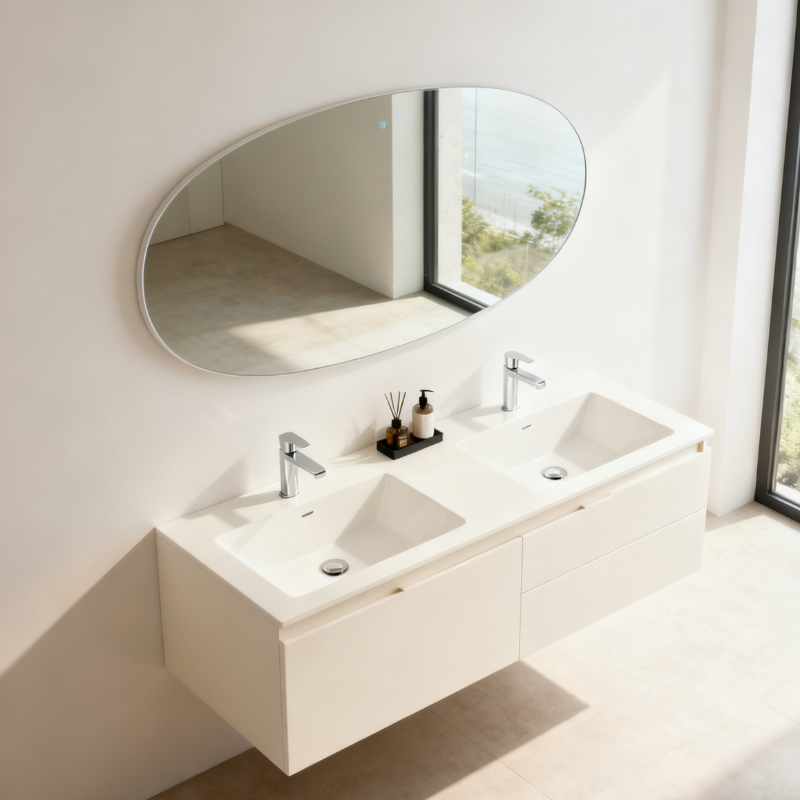
Engineering Stability: How Weight Distribution Impacts Commercial Bathroom Vanities
In a residential bathroom, a vanity only needs to support the morning routines of a single family. In a commercial hospitality or multi-family project, a bathroom vanity is subjected to immense structural stress. It must support heavy sintered stone countertops, endure the dynamic force of guests leaning on the edges, and survive the constant pulling of overfilled drawers.
When a commercial vanity fails—manifesting as sagging doors, sticking drawers, or a cracked countertop—the root cause is almost always poor weight distribution compounded by material fatigue.
For developers and B2B wholesale buyers, understanding the engineering mechanics of weight distribution is critical to protecting a project's ROI. Here is the deep B2B analysis of how weight impacts commercial vanities, and how to engineer structural stability that lasts decades.
1. The Mechanics: Static Load vs. Dynamic Load
To understand vanity stability, you must evaluate the two types of structural loads the cabinet endures:
Static Load: The constant, unchanging weight of the cabinet structure itself, the heavy quartz or marble countertop, the ceramic sink basins, and the plumbing hardware.
Dynamic Load: The shifting forces generated during daily use. This includes the pulling force when a heavy drawer is fully extended, the sudden impact of a slammed door, or a guest physically leaning against the front of the vanity.
A stable commercial vanity must feature a framework that safely transfers both the heavy static load downward, while resisting the forward-pulling forces of dynamic loads.
2. The Fatal Flaw of Traditional Wood in Commercial Loads
If a vanity is engineered perfectly on paper, why do so many hotel vanities begin to sag and shake after just two years? The answer is ambient humidity.
Most commercial vanities are constructed using MDF, particleboard, or standard plywood. In a humid hotel bathroom, these porous materials inevitably absorb airborne moisture. When MDF absorbs water, its structural density softens.
The Chain Reaction: As the vertical side panels soften from moisture, they lose their ability to support the massive static load of the heavy stone countertop. The center of the cabinet begins to imperceptibly bow downward. This bowing pinches the internal drawer slides, causing drawers to bind and stick. Eventually, the uneven weight distribution creates tension in the rigid stone countertop, causing it to fracture.
3. Key Vulnerabilities in Commercial Layouts
Certain popular commercial bathroom layouts are inherently vulnerable to weight distribution failures if not engineered correctly:
Floating (Wall-Mounted) Vanities: Highly popular in modern hotels, these vanities transfer 100% of their weight to the wall. If a heavy MDF cabinet is topped with a heavy quartz counter, the sheer stress on the wall mounting brackets is immense. Over time, the cabinet will begin to pull away from the wall, creating an unsightly and dangerous gap.
72-Inch Double-Sink Vanities: In luxury family suites, long vanities suffer from central span weakness. Without proper mid-point vertical support, the immense weight of a double-sink stone top will cause the center of the vanity to sag.
Offset Sink Configurations: When a sink is shifted completely to the left or right to provide maximum continuous counter space, the cabinet’s center of gravity shifts drastically. Without asymmetric structural reinforcement, the vanity will eventually tilt, causing door gaps to become uneven.
4. The Aerospace Solution: Engineered Metal Cores
How do commercial developers support massive stone countertops and dynamic hospitality use without relying on heavy, moisture-absorbing wood? They turn to engineered metals.
At JATAII, we manufacture our commercial bathroom vanities exclusively from Stainless Steel and aerospace-grade Aluminum Honeycomb. This shift in material science solves every weight distribution problem in commercial procurement:
Unmatched Strength-to-Weight Ratio: Aluminum honeycomb panels are engineered with a hexagonal internal core. This provides the massive structural rigidity required to support heavy sintered stone countertops without bowing a single millimeter over a 72-inch span.
Lighter Wall Loads: Despite their incredible strength, aluminum honeycomb panels are composed of 90% air. This makes them significantly lighter than solid wood or MDF, drastically reducing the sheer stress on the wall brackets of floating vanities and ensuring they never pull away from the drywall.
Absolute Moisture Resistance: Because our metals have zero porosity, they never absorb water. The structural geometry of a JATAII vanity remains exactly the same on Day 1 as it does in Year 20. The side panels will never soften, and the screws holding your heavy-duty drawer slides will never strip out.
5. Hardware Integration for Dynamic Loads
A rigid metal cabinet must be paired with commercial-grade hardware to manage dynamic weight shifts. JATAII equips our engineered metal vanities with SUS304 Stainless Steel hinges and heavy-duty, full-extension drawer slides rated for dynamic loads exceeding 75 lbs (34 kg), ensuring flawless operation even when guests overfill the drawers.
Protect Your Commercial Investment
Do not risk your hospitality project's ROI on vanities that soften and sag under their own weight. Engineering stability requires specifying materials that never degrade.
[Contact the JATAII B2B export team today] for a wholesale quote on our Aluminum Honeycomb and Stainless Steel bathroom vanities. Let our precision manufacturing provide the indestructible foundation your next project demands.
Ready to upgrade your next commercial project?
Contact JATAII today for our 2026 wholesale catalog and a free quote.
Get a Factory Quote