As bathroom cabinet markets become increasingly globalized (cross-border sales account for 40% of B-end revenue) and high-end segments grow at 8% CAGR (2024-2029), B-end clients face new growth bottlenecks: Expanding into overseas markets but failing to resonate with local cultural preferences (e.g., European minimalist vs. Middle Eastern luxury); wanting to integrate cutting-edge tech (e.g., smart sensing, IoT) but deterred by high R&D costs and complex after-sales; competing in high-end markets but lacking unique selling points (homogeneous designs, similar functions) leading to price wars.
With 20 years of global bathroom cabinet OEM experience and 2,000+ international client partnerships, we’ve built a “global-local integration + tech simplification + premium differentiation” service system. Today, we’ll share how our factory helps you achieve “localized success in global markets, low-cost tech innovation, and irreplaceable premium competitiveness” to win in high-margin segments and cross-border expansion.
I. Global-Local Operation: Deep Adaptation + Local Support—Win Overseas Markets
Expanding overseas isn’t just about “exporting products”—it requires deep cultural adaptation, local resource integration, and compliant operations. Our “global layout + local 深耕” system helps clients break through regional barriers, with 90%+ market acceptance in 30+ countries.
✅ 1. Regionalized Product Adaptation: Beyond Compliance to Cultural Resonance
We tailor products to local cultural preferences, usage habits, and market trends—avoiding “one-size-fits-all” mistakes:
- Cultural Aesthetic Adaptation:
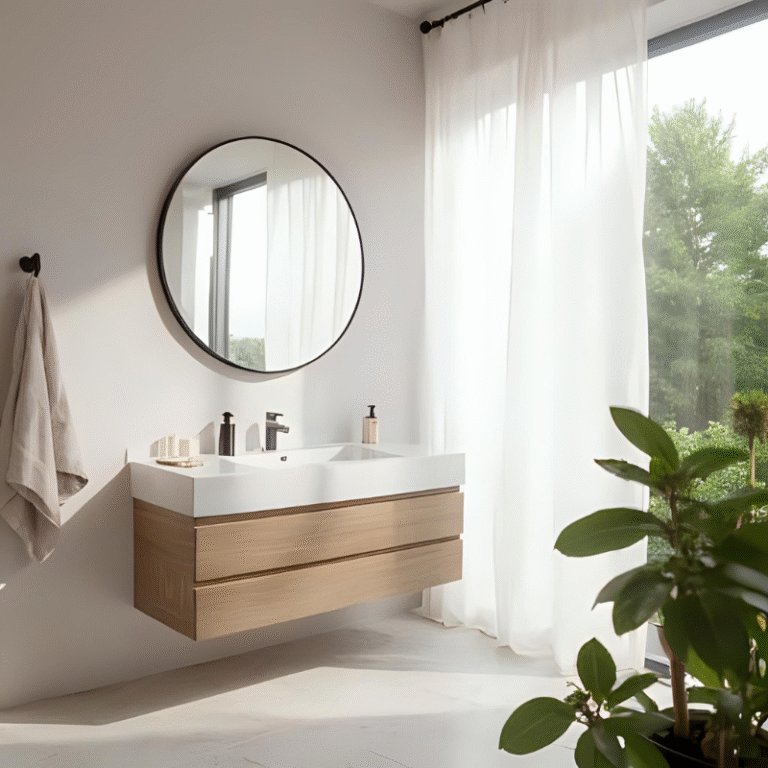
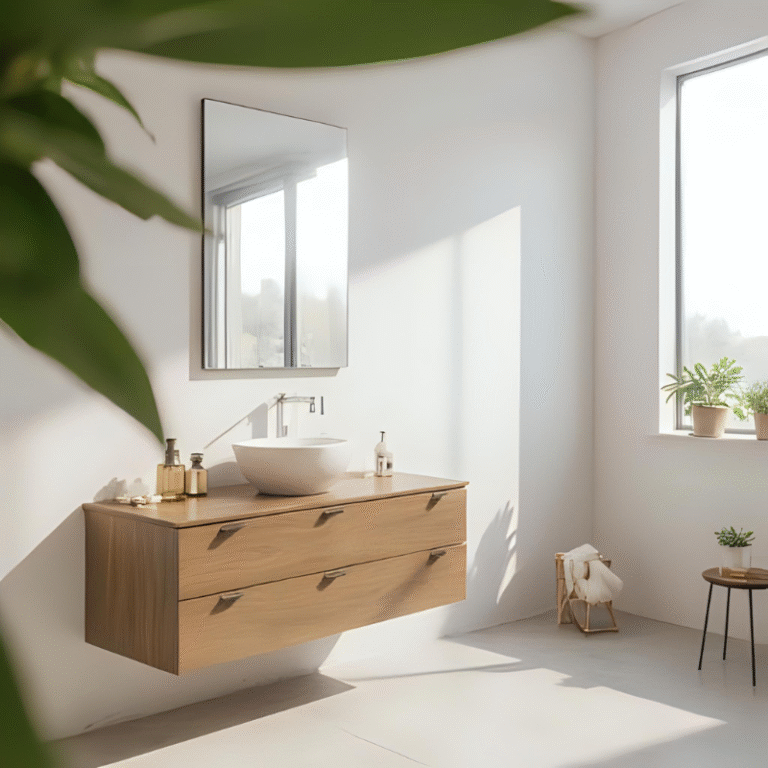
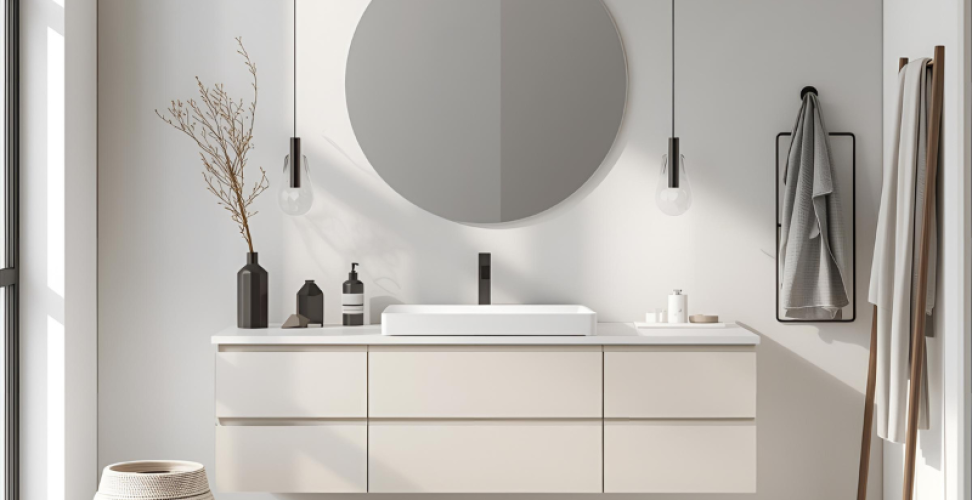
- EU Market: Minimalist design (frameless cabinets, neutral colors like matte white/gray), eco-friendly materials (recycled aluminum, FSC solid wood), and subtle textures (brushed metal, natural wood grain) aligning with “quiet luxury” trends.
- Middle Eastern Market: Opulent styles (24K gold PVD hardware, marble texture transfer), large storage capacity (100-120cm width), and privacy features (electrochromic mirror glass, lockable compartments) matching local luxury preferences.
- Southeast Asian Market: Moisture-proof PVC/aluminum materials, compact sizes (60-80cm width) for small bathrooms, and bright colors (beige, light wood grain) adapting to high-humidity climates and aesthetic tastes.
- Usage Habit Alignment:
- US Market: Integrated smart functions (motion-sensor lighting, wireless charging) and ADA-compliant designs (height-adjustable shelves, grab bars) for aging-in-place trends.
- Japanese Market: Ultra-thin depth (12-15cm), rounded edges (5mm radius), and modular assembly (easy to move) fitting small, minimalist bathrooms.
Case Study: A Chinese cross-border seller wanted to enter the UAE luxury home market. We customized “gold-plated hardware + marble texture aluminum cabinets” with large storage compartments and privacy mirrors—products sold at AED 1,299/unit (35% higher than regular models) and became a bestseller on Noon.com, with 60% of sales coming from local villa projects.
✅ 2. Local Resource Integration: Help Clients Quickly Access Overseas Channels
SMBs lack local resources to expand overseas—we share our global network to reduce market entry costs:
- Local Channel Connection: Partner with 500+ local retailers, home centers, and hotel procurement platforms (e.g., EU’s BoConcept, US’s Williams Sonoma Home, Middle East’s Home Centre) —introduce clients to suitable channels based on their product positioning. Provide “localized product display kits” (customized stands, multilingual manuals) to help clients enter offline stores.
- Local Service Partner Network: Cooperate with 200+ local installation and after-sales teams in 30+ countries—provide on-site installation, maintenance, and repair services for clients’ overseas orders. For example, a US hotel project’s cabinet installation is completed by local technicians within 48 hours of delivery.
- Localized Marketing Support: Provide multilingual marketing materials (10+ languages: English, German, Arabic, Japanese) and regional trend reports (e.g., “2025 EU bathroom cabinet color trends: soft gray”). Help clients register local trademarks and participate in overseas exhibitions (e.g., EU’s Maison&Objet, US’s High Point Market) with group booth discounts.
Case Study: A Vietnamese regional distributor wanted to export to Australia. We connected them to Australia’s Home Hardware retail chain, provided English compliance documents and marketing materials, and arranged local after-sales support—their PVC moisture-proof cabinets entered 20 Home Hardware stores, with monthly sales of 300+ units.
✅ 3. Regional Compliance Sinking: Avoid “Hidden Pitfalls” in Overseas Markets
Different regions have strict, detailed regulations—we provide “regional compliance turnkey packages” to ensure smooth market entry:
- EU Market: REACH 211-substance testing, ECODESIGN packaging (100% recyclable), EU Ecolabel certification, and multi-language manuals (English, German, French, Spanish).
- US Market: CARB Phase 2 certification for wood products, UL certification for electrical components, California Proposition 65 warning labels, and ADA compliance for accessible designs.
- Middle Eastern Market: SIRIM certification (Malaysia), SNI certification (Indonesia), anti-mold testing (ASTM D3273 Grade 0), and Halal certification (optional for Muslim-majority countries).
- Compliance Update Service: Proactively notify clients of regulatory changes (e.g., EU’s new REACH restricted substances list) and provide free adjustments (e.g., updating material formulations) to avoid market withdrawal.
Case Study: A European startup almost faced EU customs detention due to missing REACH documentation. We provided a complete compliance package (test reports, certification certificates, multi-language labels) within 3 days—helping them clear customs and avoid a $5,000 fine.
II. Lightweight Tech Innovation: Low-Cost, High-Impact—Tech That’s Easy to Implement
B-end clients want to use new technologies to enhance product competitiveness but fear “high R&D costs + complex after-sales”—a single smart module can cost $30k+ in independent development. Our “modular tech toolkit + low-code integration” system lets clients add cutting-edge functions with MOQ 20 units, no professional R&D team required.
✅ 1. Plug-and-Play Smart Modules: No R&D, Direct Integration
We pre-develop 15+ lightweight smart modules with standardized interfaces—clients can “plug in” to any cabinet, reducing tech implementation costs by 60%:
- Smart Sensing Module:
- Function: Motion-sensor lighting (auto-on when approaching 1m, auto-off after 5 minutes), humidity-triggered anti-fog (activates when RH ≥70%), and door-open reminder (alerts if cabinet is left open for 10 minutes).
- Cost & MOQ: $18/unit, MOQ 20 units—no extra wiring, compatible with all cabinet types.
- IoT Mini Hub Module:
- Function: Connects to clients’ brand app (we provide a low-code app template for free) to remotely control lighting/anti-fog, monitor cabinet usage (e.g., “drawer opened 5 times/day”), and send maintenance reminders (e.g., “hinges need lubrication”).
- Cost & MOQ: $25/unit, MOQ 25 units—supports OTA updates for function upgrades.
- Health Monitoring Module:
- Function: Embeds a non-contact sensor to measure skin moisture/oil and ambient temperature/humidity—displays data on the mirror and syncs to the app, providing simple skincare recommendations (e.g., “High humidity—use oil-control products”).
- Cost & MOQ: $30/unit, MOQ 30 units—no privacy concerns (data stored locally on the module).
Case Study: A US DTC brand added the smart sensing + IoT hub modules to 50 units of aluminum cabinets. Total tech cost was
43/unit,andtheypricedtheproductat299 (28% higher than non-smart models). The app-connected function became a key selling point, with 40% of customers leaving positive reviews about “convenient smart control”—sales increased by 35% in 2 months.
✅ 2. Low-Code Integration: Customize Smart Functions Without Coding
For clients needing personalized smart logic (e.g., “hotel PMS system integration”), we provide a “low-code platform”—no coding experience required:
- Visual Configuration: Clients drag-and-drop function blocks (e.g., “motion sensor → turn on light → delay 5 minutes → turn off”) to customize smart workflows.
- System Compatibility: Integrates with third-party systems (e.g., hotel PMS, home smart hubs like Alexa/Google Home) via pre-built APIs—no need for custom development.
- Cost Advantage: Custom smart logic costs 500−1,000(vs.10k+ for traditional R&D), MOQ 50 units.
Case Study: A European hotel chain wanted to integrate cabinets with their PMS system (door opening triggers room lighting). Using our low-code platform, we completed the integration for $800—cabinets automatically sync with room status, and the hotel’s guest satisfaction score for bathrooms increased by 22%.
✅ 3. Simplified Tech After-Sales: SMBs Can Handle It
We solve the “tech after-sales headache” for clients with self-service tools and local support:
- Troubleshooting Toolkit: Include video QR codes for common tech issues (e.g., “app connection failure” “sensor unresponsive”)—local installers can resolve 90% of problems in 10 minutes.
- Local Tech Support: Partner with local tech teams in key markets—complex issues (e.g., system integration errors) are resolved by local technicians within 48 hours.
- Module Replacement Guarantee: Defective tech modules are replaced for free within 2 years—stocked in overseas warehouses for fast delivery.
Case Study: A Singaporean cross-border seller’s 10 units had IoT hub connection issues. Our local tech team resolved 8 via video guidance, and 2 replacement modules arrived in 2 days—no extra cost, and the seller’s customer satisfaction remained 4.7/5.
III. Premium Differentiation Empowerment: Build Irreplaceable Competitiveness in High-End Markets
High-end markets (unit price ≥$300) are crowded with homogeneous products—our “design + material + brand” differentiation system helps clients stand out, with brand premium increased by 25%-40%.
✅ 1. Exclusive Design Collaboration: Create Unique Aesthetic Identity
We help clients develop exclusive designs to avoid homogenization—no extra cost for small batches:
- Designer Co-Branding: Partner with 50+ international interior designers (e.g., European minimalist designers, Japanese spatial designers) to co-create limited-edition cabinet lines. Clients get exclusive design rights for 2 years—MOQ 30 units, design fee shared 50-50 (waived for annual orders ≥500 units).
- Custom Aesthetic Details: Support exclusive surface treatments (e.g., hand-painted patterns, laser-engraved art) and structural designs (e.g., asymmetric cabinets, curved drawer fronts) —MOQ 20 units, no mold fees.
- Trend Forecasting Support: Provide quarterly high-end design trend reports (e.g., “2025 premium color: deep olive green” “material trend: aluminum + natural stone combination”) to guide clients’ design decisions.
Case Study: A European luxury home brand collaborated with a Milanese designer to launch a limited-edition “curved aluminum cabinet with hand-painted patterns.” MOQ 30 units, unit price €399 (40% higher than regular models)—sold out in 3 weeks, and the brand’s high-end image was significantly enhanced.
✅ 2. High-End Material Upgrade: Cost-Effective Value Enhancement
We recommend “high-value material upgrades” that enhance premium perception without drastically increasing costs:
- Material Combination: Aluminum + natural stone countertop (e.g., marble, quartz) —unit cost increased by $30, but perceived value rises by 50%.
- Rare Material Accents: Add small amounts of rare materials (e.g., mother-of-pearl inlays on handles, carbon fiber trim) —cost $10-15/unit, but creates “luxury details” that attract high-net-worth consumers.
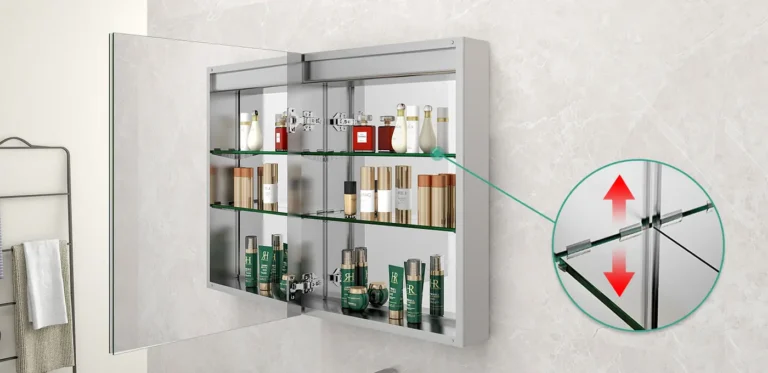
- Durability Upgrade: Use aerospace-grade 6061-T6 aluminum (tensile strength 290MPa) and Blum soft-close hinges (200,000 opening cycles) —extend product lifespan to 8-10 years, supporting a 5-year warranty (vs. 2 years industry average).
Case Study: A US high-end distributor upgraded to “aluminum + quartz countertop” cabinets with Blum hinges. Unit cost increased by
28,butunitpriceroseby80 (to $349), and the product was adopted by 5 luxury villa projects—gross margin increased from 40% to 55%.
✅ 3. Brand Story & Certification Empowerment: Build High-End Credibility
High-end consumers buy “brand value”—we help clients build credible premium stories:
- Craft Storytelling: Provide production process videos (e.g., “12 manual checks for seamless welding” “hand-polished surface treatment”) and craftsman interviews—highlight “artisanal quality” for marketing.
- Premium Certifications: Help clients obtain high-end certifications (e.g., Cradle to Cradle, LEED Gold, EU Ecolabel) —these certifications are key trust signals for high-net-worth consumers.
- Private Labeling & Packaging: Support high-end private labeling (laser-engraved logos, embossed brand names) and luxury packaging (rigid gift boxes, velvet lining, seed paper filler) —packaging cost $12-15/unit, enhancing unboxing experience.
Case Study: A Japanese luxury brand used our craft videos and Cradle to Cradle certification to market their aluminum cabinets. The brand’s website featured “artisanal production” stories, and the luxury packaging received rave reviews—product sales in high-end department stores (e.g., Mitsukoshi) increased by 40%, with a 35% brand premium.
IV. Our OEM Cooperation Advantages: Three Core Drivers of High-End Growth
- Global-Local Capability: Regionalized product adaptation, local resource integration, and compliance support help clients enter 30+ overseas markets with 90%+ acceptance.
- Tech Accessibility: Lightweight smart modules and low-code integration reduce tech implementation costs by 60%, making high-end tech accessible to SMBs.
- Premium Differentiation: Exclusive design, high-end material upgrades, and brand storytelling help clients command 25%-40% product premium, avoiding price wars.
V. Simple Cooperation Process: Start Your Global Premium OEM Project
- Demand Clarification: Share your target markets (e.g., UAE luxury segment), tech needs (e.g., smart sensing), and premium positioning (e.g., designer co-branded) —we provide a detailed plan and quote within 24 hours.
- Prototype & Design Confirmation: Produce 1-2 samples (3-5 days) with your chosen tech modules and design details—modify until satisfied (free for 2 rounds of adjustments).
- Mass Production & Global Support: Start production → provide localized packaging and compliance documents → arrange local delivery and after-sales support → offer marketing materials for global promotion.
Conclusion: Your Partner for Global Premium Success
In the era of “globalization + high-endization,” bathroom cabinet OEM cooperation is no longer about “producing cabinets”—it’s about helping you win in overseas markets, innovate with low cost, and build irreplaceable premium competitiveness. Our global-local operation, lightweight tech innovation, and premium differentiation solutions are designed to help you break through growth bottlenecks, seize high-margin opportunities, and become a leader in your target markets.