With the booming development of the global rental housing market and the increasing popularity of small-space living, bathroom mirrors are facing new demand trends focusing on “space-saving, cost control, and efficient landing”. B-end clients such as small-apartment operators, rental housing brands, affordable home retail chains, and urban renewal project parties are facing pain points that traditional bathroom mirror OEM services cannot solve: Products cannot adapt to small or irregular bathroom spaces, resulting in wasted space; high production costs make it difficult to achieve cost-effective pricing for mass-market products; complex installation processes increase construction costs and delay project schedules; slow product iteration cannot keep up with the update rhythm of rental housing and affordable home markets.
With 18 years of experience in bathroom mirror R&D and production, and relying on a cost-controlled supply chain and lightweight production technology, we have built a “space-saving + cost-effective + efficient” OEM service system centered on “space-optimized adaptation + cost-effective mass production + easy installation & iteration”. Today, we will share how our factory leverages product design and production advantages to help you break through market bottlenecks and achieve efficient development in the mass-market bathroom mirror segment.
I. Space-Optimized Adaptation: Create Multi-Functional Space-Saving Solutions
Small bathrooms (≤4㎡) and irregular-shaped bathroom spaces (e.g., corner areas, sloped ceilings) are common in rental housing and small apartments. Traditional large-sized, single-functional bathroom mirrors cannot fit these spaces. We focus on space utilization and develop multi-functional, space-adaptive bathroom mirrors to maximize bathroom space value.
✅ 1. Space-Saving Structural Design
- Foldable & Telescopic Mirrors: Launch foldable bathroom mirrors with a folding angle of 0-90°. When not in use, they can be folded against the wall, reducing occupied space by 60%. For corner bathrooms, develop telescopic arm mirrors (telescopic range 30-50cm) that can be adjusted freely according to usage needs, making full use of corner space. The frame uses lightweight aluminum alloy (weight ≤3kg), avoiding wall load-bearing pressure.
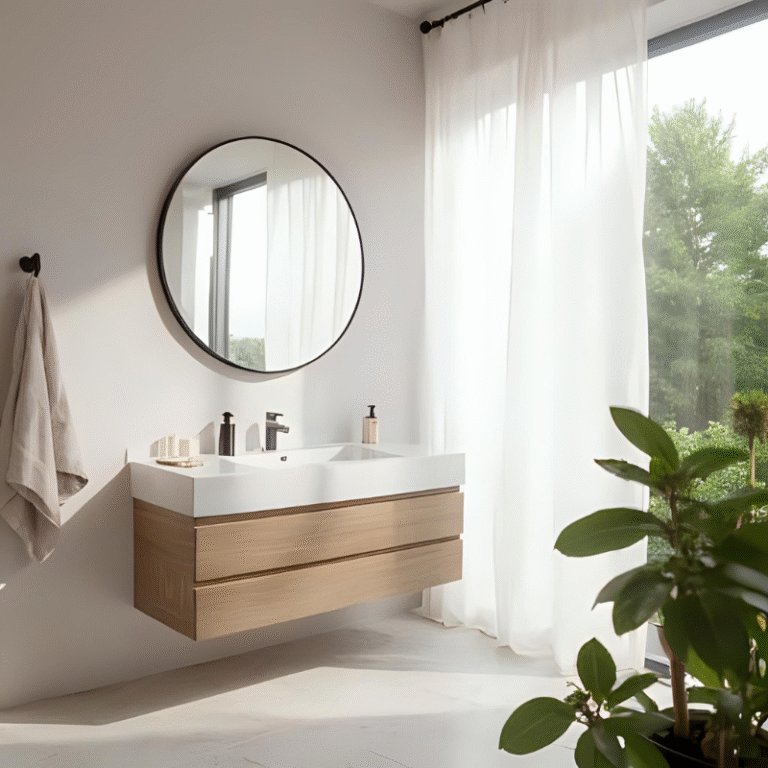
- Custom Irregular Shapes: Support custom mirror shapes for irregular spaces, such as fan-shaped mirrors for arc-corner bathrooms, trapezoidal mirrors for sloped-ceiling bathrooms, and L-shaped mirrors for corner-wrapping spaces. The minimum size can be as small as 30×40cm, perfectly fitting small bathroom layouts. Provide 3D space simulation services to ensure the mirror fits the space precisely (size tolerance ±1mm).
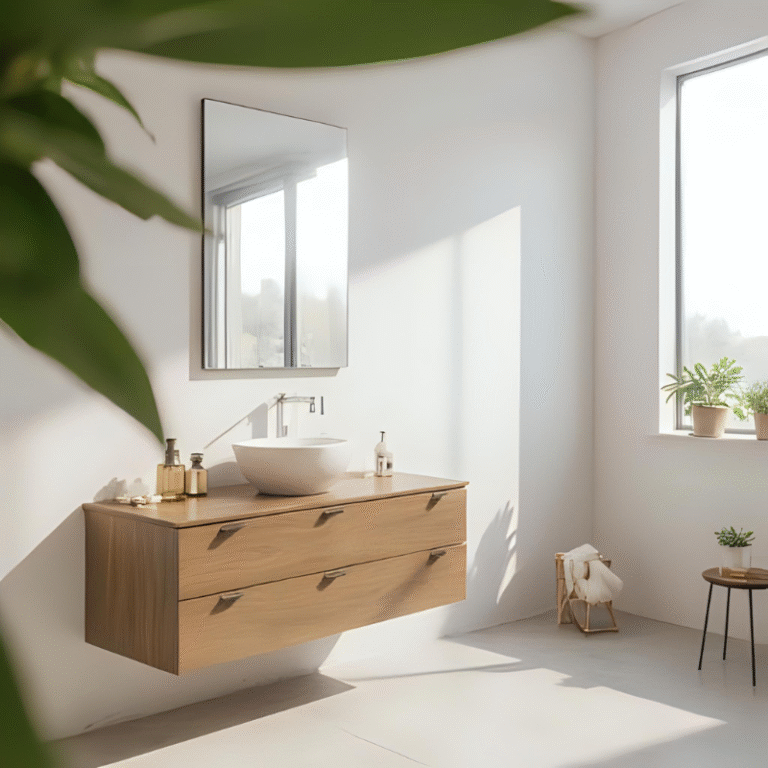
- Thin & Lightweight Design: Optimize the mirror structure, using ultra-thin backplanes (thickness 5mm) and lightweight frame materials. The overall thickness of the mirror is controlled within 2.5cm (30% thinner than traditional mirrors), reducing visual oppression in small spaces. The hanging design adopts hidden brackets, further enhancing the sense of space.
✅ 2. Multi-Functional Integration to Save Space
Integrate storage and practical functions into the mirror to avoid additional storage furniture occupying space:
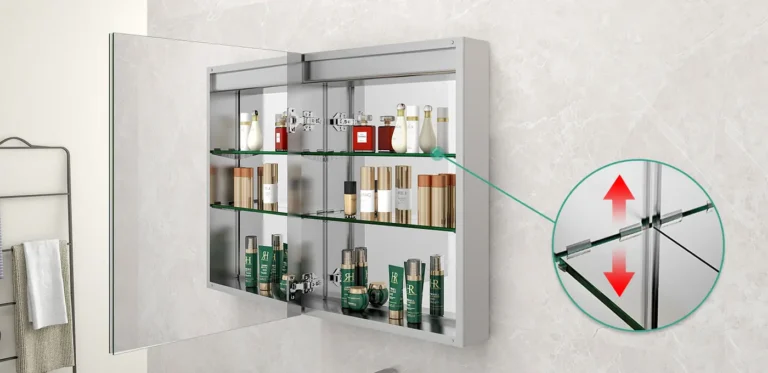
- Mirror-Cabinet Integrated Design: Develop wall-mounted mirror cabinets with built-in storage compartments (divided into dry and wet areas). The dry area is used to store toiletries (toothbrushes, cosmetics), and the wet area is equipped with waterproof partitions for storing towels. The cabinet door adopts push-to-open design (no handles), saving space and avoiding collision risks. The storage capacity can reach 8-15L, meeting daily storage needs.
- Built-In Small Functions: Integrate practical small functions such as hook racks (for hanging towels, bath balls) and toothbrush holders on the side or bottom of the mirror. The hooks are foldable and can be put away when not in use. For rental housing, add a detachable storage basket that can be freely installed and removed according to tenant needs.
Case Study: A domestic rental housing brand ordered 1,500 units of our foldable mirror cabinets for its small-apartment projects (average bathroom area 2.8㎡). The foldable design and integrated storage function solved the space shortage problem of small bathrooms. The installation was simple, and the project construction period was shortened by 15%. Tenants’ satisfaction with bathroom space utilization reached 94%, and the brand renewed the order for 3,000 units for subsequent projects.
II. Cost-Effective Mass Production: Balance Quality & Cost for Mass Market
For affordable home retail chains and rental housing operators, cost control is the core demand, but product quality cannot be compromised (e.g., durability, safety). Traditional OEM factories either cut corners to reduce costs or have high prices that cannot meet mass-market demand. We build a cost-effective mass production system through raw material optimization, process upgrading, and scale production, achieving “high quality at low cost”.
✅ 1. Raw Material Optimization & Cost Control
- High-Cost-Performance Material Selection: Adopt high-quality but cost-effective materials, such as high-transmittance silver mirror glass (light transmittance ≥88%) that meets national safety standards (tempered, impact-resistant), and 6061 aluminum alloy frames (corrosion-resistant, lightweight) with optimized thickness (1.2-1.5mm, ensuring strength while reducing material usage). For hardware accessories, use high-quality domestic brand components (service life ≥50,000 cycles) instead of imported brands, reducing hardware costs by 30%.
- Bulk Sourcing & Supply Chain Integration: Integrate 50+ upstream raw material suppliers to achieve bulk joint procurement. The cost of mirror glass and aluminum alloy is 15-20% lower than that of small-batch procurement. Establish long-term strategic cooperation with suppliers to lock in material prices, avoiding cost fluctuations caused by raw material price increases.
✅ 2. Automated Production & Process Upgrading
Reduce production costs and improve efficiency through automated production lines and process optimization:
- Fully Automated Production Lines: Equip 20+ automated production lines covering glass cutting, edge polishing, frame assembly, and surface spraying. The automation rate reaches 85%, reducing manual labor costs by 40%. The production capacity of a single line reaches 800 units/day, ensuring cost advantages for mass production (orders ≥1000 units).
- Process Simplification & Efficiency Improvement: Optimize the production process, such as integrating the mirror glass and backplane bonding process into one step (reducing production time by 20%), and using spray-free aluminum alloy frames (avoiding the spraying process, reducing costs by 12%). The product qualification rate is maintained at ≥99.5% while simplifying processes.
✅ 3. Standardized Module Production
Adopt a “standardized core module + optional function” model to reduce R&D and production costs:
- Standardized Core Modules: Unify the core modules of bathroom mirrors (glass, frame, basic lighting, installation brackets), realizing batch production of core components and reducing production costs. The standardized modules have passed long-term durability tests, ensuring product stability.
- Optional Cost-Controlled Functions: Clients can choose to add basic functions (anti-fog, simple lighting) according to needs. The anti-fog module uses cost-effective semiconductor anti-fog technology (cost 50% lower than heating anti-fog), and the lighting module uses energy-saving LED light strips (power consumption ≤8W, service life ≥30,000 hours), balancing functionality and cost.
Case Study: A national affordable home retail chain ordered 5,000 units of our standardized bathroom mirrors. Through bulk sourcing, automated production, and standardized modules, we reduced the unit cost by 25% compared to the industry average. The product was priced at $39.9/unit, which was well-received in the mass market. The retail chain’s monthly sales of the product reached 800+ units, and we signed a annual supply agreement of 30,000 units.
III. Easy Installation & Rapid Iteration: Support Efficient Project Landing & Market Update
Rental housing projects and urban renewal projects require fast installation to shorten the construction period; affordable home retail chains need to update products quickly to keep up with market trends. Traditional bathroom mirrors have complex installation processes and long iteration cycles, which cannot meet these needs. We focus on “easy installation” and “rapid iteration” to provide efficient supporting services.
✅ 1. Easy Installation Design & Supporting Services
- Tool-Free & Drilling-Free Installation: Develop wall-mounted bathroom mirrors with adhesive + suction cup dual fixing design (bearing capacity ≥10kg) for small and medium-sized mirrors (≤60×80cm), realizing tool-free and drilling-free installation. The installation can be completed in 5 minutes by 1 person, avoiding damage to the wall (suitable for rental housing that cannot be drilled). For large-sized mirrors, provide pre-installed hanging brackets and detailed installation manuals, with installation time reduced by 60% compared to traditional mirrors.
- Installation Training & On-Site Guidance: Provide free installation training videos and online technical consultation for project clients. For large-scale projects (≥1000 units), send professional technical teams to the site to conduct installation training for construction workers, ensuring installation efficiency and quality. The technical team can solve on-site installation problems in real time, reducing rework rates.
✅ 2. Rapid Product Iteration Capability
Meet the market update needs of home retail chains through fast R&D and small-batch flexible production:
- Fast R&D of New Styles: Establish a market trend research team to track the latest styles and color trends of bathroom mirrors (e.g., minimalist frameless, Nordic light color frames). The R&D cycle of new styles is only 7-10 days (industry average is 20-30 days). Provide 3-5 new style samples for clients to choose from every quarter.
- Small-Batch Flexible Production for New Styles: Support small-batch production of new styles with a minimum order quantity of 50 units, helping clients test market response without large-scale inventory risks. The production cycle for small-batch new styles is 5-7 days, enabling clients to quickly launch new products to the market.
✅ 3. Replacement & Maintenance Convenience
For rental housing clients, the convenience of product replacement and maintenance directly affects operational costs:
- Detachable & Replaceable Components: Adopt a detachable design for key components (mirror glass, frame, lighting module). If a component is damaged, it can be replaced independently without replacing the entire mirror, reducing maintenance costs by 70%.
- Low-Cost Spare Parts Supply: Provide spare parts (mirror glass, light strips, brackets) at factory direct prices, with a spare parts supply cycle of 1-2 days. Set up a dedicated after-sales team for rental housing clients, providing 24-hour technical support for maintenance problems.
Case Study: An urban renewal project party in Chengdu ordered 2,000 units of our tool-free installation bathroom mirrors for old community renovation. The tool-free installation design reduced the project’s installation labor cost by 50%, and the construction period was shortened by 10 days. After the project was completed, the project party praised the installation efficiency and product cost-effectiveness, and recommended us to 2 other urban renewal projects. A home retail chain launched 3 new styles of our bathroom mirrors, with small-batch test sales of 100 units each. The market response was positive, and the chain quickly scaled up to 1,000 units per style.
IV. Simple OEM Cooperation Process for Mass-Market Bathroom Mirror Projects
- Demand & Cost Confirmation: Share your project type (rental housing/small apartment/affordable retail), target price, core needs (space adaptation, installation method, order quantity), and delivery timeline. We will provide a cost-effective solution, product specification sheet, and quotation within 24 hours.
- Sample & Quality Confirmation: Produce 1-2 samples (3-5 days) for design, size, and function testing. Support 1 round of free modification according to your needs, and confirm product quality and cost control indicators.
- Mass Production & Delivery: Confirm the sample → pay 30% deposit → start mass production (automated production + strict quality inspection) → pay 70% balance → batch delivery. Provide installation manuals and quality inspection reports.
- Installation Support & After-Sales Service: Provide installation training and technical support → activate after-sales service (2-year free warranty for core components) → provide spare parts supply and maintenance guidance → track market feedback and provide product iteration suggestions.