
Bathroom Cabinet OEM Manufacturer 13.0: AI-Driven Demand Matching + Ultimate Flexible Customization 2.0 + Global Dynamic Compliance + Secure Data Monetization
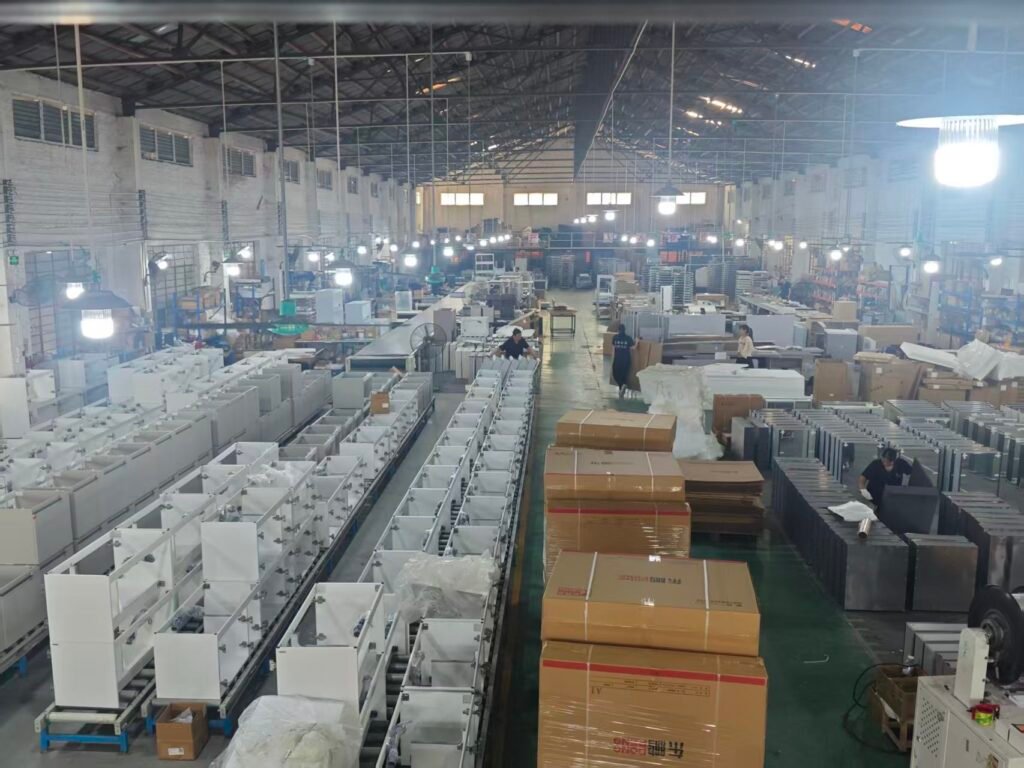
As the bathroom cabinet industry evolves towards “precision, speed, and intelligence,” B-end clients face new pain points that traditional OEM services cannot address: Demand mining relies on subjective experience, leading to 30%+ unsold inventory due to mismatched market needs; flexible customization still has bottlenecks (e.g., MOQ ≥10 units, 48-hour proofing cycle) that cannot meet ultra-personalized and fast-turnover demands; global compliance policies update frequently (e.g., EU REACH adds 5+ restricted substances annually), and manual adaptation lags behind, resulting in customs detention risks; client data (e.g., end-user preferences, sales trends) is scattered and cannot be safely monetized, wasting valuable assets. With 20 years of bathroom cabinet OEM experience and in-depth layout of AI technology, intelligent production, and global compliance resources, we’ve built an “intelligent + agile + compliant + value-added” service system focused on “AI-driven precise demand matching + ultimate flexible customization 2.0 + global dynamic compliance adaptation + secure customer data monetization”. Today, we’ll share how our factory helps you achieve “precision in demand, speed in customization, security in compliance, and value in data” to break through the growth bottleneck of blind production and passive adaptation. I. AI-Driven Precise Demand Matching: From “Blind Production” to “Demand-Oriented Customization”—Unsold Inventory Reduced by 60% Traditional OEM production relies on “client subjective needs + market experience,” leading to frequent mismatches between products and market demand. Our “AI demand prediction & matching system” integrates multi-dimensional data analysis to achieve “demand prediction → scheme generation → product customization” closed loop, helping clients increase hit rate of new products to 90% and reduce unsold inventory by 60%. ✅ 1. Multi-Dimensional Demand Data Mining: Capture True Market Needs We use AI to integrate global market data and client business data, solving the pain point of “superficial demand mining”: Case Study: A European home brand struggled with unsold inventory of solid wood cabinets (accounting for 28% of stock). Our AI analyzed their sales data and EU market trends, finding that “recycled aluminum + minimalist hidden storage” was a high-demand unmet need. We generated a customized product plan, and the brand launched 50 units—sold out in 2 weeks, unsold inventory reduced by 70% in the next quarter. ✅ 2. AI-Generated Custom Solutions: One-Click Realize “Demand → Product” AI automatically converts demand into feasible product solutions, reducing communication and design cycles by 80%: Case Study: A US cross-border seller wanted to launch a “smart small bathroom cabinet” for urban renters. Our AI generated 4 solutions in 10 minutes, simulated sales performance, and recommended the “50cm width + touch-sensitive light + foldable shelf” scheme. The seller ordered 30 units (MOQ 5 units) —sold 150+ units in 1 month, gross margin 58%, far exceeding their initial expectation of 40%. II. Ultimate Flexible Customization 2.0: MOQ 5 Units + 24-Hour Proofing + Full-Automated Customization—Custom Efficiency Up by 80% Previous flexible production still has limitations (MOQ ≥10 units, proofing cycle ≥2 days) that cannot meet ultra-small-batch testing and instant customization needs. Our “ultimate flexible customization 2.0 system” integrates full-automated production lines, 3D printing rapid prototyping, and modular intelligent assembly, realizing “MOQ 5 units, 24-hour proofing, 7-day bulk delivery” and reducing custom cost by 40%. ✅ 1. Ultra-Low MOQ + Rapid Prototyping: Break Customization Limits We break the bottom line of custom MOQ and proofing cycle to support ultra-small-batch market testing: Case Study: A Southeast Asian regional distributor wanted to test 5 units of “pet-themed small cabinets” for young pet owners. We completed 3D printed prototypes in 24 hours, adjusted according to feedback in 8 hours, and delivered 5 units in 5 days. The test batch sold out in 3 days, and the distributor scaled up to 200 units—customization efficiency increased by 85% compared to their previous supplier. ✅ 2. Full-Automated Custom Production Line: Zero Error + Fast Delivery We build “customization-oriented automated production lines” to solve the pain points of “slow speed and high error rate” in manual customization: Case Study: A European engineering firm ordered 20 units of irregular-shaped aluminum cabinets for a boutique hotel. Our automated production line completed cutting, processing, and assembly in 6 days—batch consistency error ≤0.3mm, and delivery was 4 days earlier than the client’s expected 10 days. The firm’s project handover was advanced by 3 days, avoiding a $10,000 construction delay penalty. III. Global Dynamic Compliance Adaptation: Real-Time Policy Tracking + Automatic Product Adjustment—Compliance Risk Reduced by 90% Global compliance policies (environmental, safety, trade) update frequently (average 15+ times/year per region), and manual adaptation is slow and error-prone. Our “global dynamic compliance adaptation system” realizes “policy real-time tracking → automatic product adjustment → compliance document generation” full-link automation, helping clients avoid customs detention and market withdrawal risks. ✅ 1. Global Compliance Policy Real-Time Monitoring: Early Warning of Policy Changes We build a “global compliance policy database” to track changes in real time and send early warnings: Case Study: A US home brand’s aluminum cabinets faced a new California Proposition 65 chemical limit update. Our system sent an alert 4 months in advance, simulated the impact (material replacement cost + certification update time), and recommended a low-VOC coating alternative. The brand completed product adjustment before the policy took effect, avoiding a 6-month market suspension and $30,000 in losses. ✅ 2. Automatic Product Compliance Adjustment: Zero Manual Intervention The system automatically adjusts product parameters to meet new compliance requirements, reducing adaptation cycle by 70%: Case Study: The EU updated its eco-design directive for bathroom furniture in 2024, requiring 10% higher energy efficiency for smart modules. Our system automatically adjusted the LED module’s power consumption (from 5W to 4.5W) and updated the compliance document— a European cross-border seller’s 100-unit order was adjusted without manual intervention, successfully cleared customs and maintained sales continuity. ✅ 3. Compliance Certification Fast-Track Service: Shorten Certification Cycle by 50% We cooperate with global authoritative certification institutions to provide fast-track services, solving the pain point of “long certification cycle”: Case Study: A Southeast Asian distributor needed to export 200 units of PVC cabinets to Indonesia and required SNI certification. Our fast-track service completed pre-testing in 3 days, third-party certification
Bathroom Cabinet OEM Manufacturer 12.0: Full-Link Digital Twin Collaboration + Cross-Border Ecosystem Integration + After-Sales Value-Added Closed Loop

As the bathroom cabinet industry enters the “digitalization + ecologicalization” era, B-end clients face new operational pain points that traditional OEM services cannot solve: The entire cooperation process (design, production, logistics, installation) relies on fragmented information, leading to unclear progress and frequent misunderstandings; they want to expand into integrated bathroom solutions but lack resources for cross-border cooperation (e.g., bathroom hardware, smart appliances, design platforms); after-sales services are limited to simple repairs, failing to tap into secondary sales opportunities (e.g., product upgrades, accessory replacements), resulting in wasted customer resources. With 20 years of bathroom cabinet OEM experience and in-depth layout of digital technology and industrial ecological resources, we’ve built a “digital + ecological + value-added” service system focused on “full-link digital twin collaboration + cross-border ecosystem resource integration + after-sales value-added closed loop”. Today, we’ll share how our factory helps you achieve “transparent and efficient collaboration, expanded business boundaries, and increased after-sales profits” to break through the single-product operation bottleneck and build a comprehensive competitive advantage. I. Full-Link Digital Twin Collaboration: Visualization + Predictability + Traceability—Collaboration Efficiency Up by 70% Traditional OEM collaboration suffers from “information asymmetry” and “process opacity”—clients can only passively inquire about progress, and potential risks (e.g., production delays, logistics damage) cannot be predicted in advance. Our “full-link digital twin system” maps the entire process from design to after-sales into a digital model, realizing real-time visualization, risk prediction, and full traceability, reducing collaboration costs by 40%. ✅ 1. Digital Twin Design & Production: Preview Effects + Predict Risks We use digital twin technology to replicate physical production lines and product models, solving the pain points of “unclear design effects” and “unpredictable production risks”: Case Study: A European engineering firm customized 100 units of irregular-sized aluminum cabinets for a villa project. Our digital twin system generated a 3D model matching the villa’s bathroom scene, and the client found a size conflict with the shower door in advance. We adjusted the design online, avoiding $15,000 in rework costs. During production, the system predicted a coating equipment failure and switched to a backup line—delivery was on time, and collaboration efficiency increased by 75%. ✅ 2. Digital Twin Logistics & Installation: Track Trajectory + Simulate Installation We extend digital twin technology to logistics and installation, solving the pain points of “unclear logistics trajectory” and “difficult installation debugging”: Case Study: A US cross-border seller ordered 50 units of smart cabinets—via the digital twin platform, they tracked the entire logistics process from Mexico factory to US warehouse, and received an alert when a cabinet was slightly shocked during transportation. We arranged for local technicians to inspect and repair it in advance, avoiding customer complaints. The AR installation guidance helped the seller’s installers complete 50 units of installation in 2 days (vs. 4 days for traditional installation). ✅ 3. Digital Twin After-Sales: Trace Usage + Predict Maintenance The digital twin system continues to play a role after delivery, realizing “predictive maintenance” and “full-life traceability”: Case Study: A Southeast Asian hotel chain used our digital twin after-sales system to manage 200 units of smart cabinets. The system predicted that 15 units’ hinges needed lubrication and sent reminders—hotel staff performed maintenance in advance, avoiding unexpected failures. The full-life traceability data helped the hotel quickly locate the batch of cabinets with a coating issue, and we replaced them within 3 days—guest complaints reduced by 80%. II. Cross-Border Ecosystem Resource Integration: One-Stop Solution + Business Expansion—Revenue Boundaries Extended by 50% Most B-end clients operate in a single category (only bathroom cabinets) and lack resources to expand into “integrated bathroom solutions”—they miss the high-margin market of one-stop procurement (e.g., hotels, engineering projects). Our “cross-border ecosystem resource pool” integrates upstream and downstream resources, helping clients extend their business boundaries from single cabinets to integrated solutions, increasing revenue per client by 40%. ✅ 1. Upstream Supply Chain Resource Integration: Cost Reduction + Quality Upgrade We share top upstream resources with clients, solving the pain points of “high material costs” and “limited quality options”: Case Study: A Chinese home brand participated in our joint procurement of FSC solid wood and Blum hinges—material costs reduced by 12%, and the brand launched “solid wood cabinet + Blum hinge” bundles. The bundle price was 399/unit(vs.320 for single cabinets), and 60% of clients chose the bundle—annual revenue increased by $200,000. ✅ 2. Cross-Category Resource Integration: Expand into Integrated Bathroom Solutions We integrate cross-category resources (smart appliances, bathroom fixtures, lighting) to help clients provide one-stop solutions: Case Study: A US hotel chain ordered 200 units of “cabinet + smart toilet + bathroom heater” packages from us. The pre-developed linkage module realized “cabinet door opening triggers toilet lid lifting and heater activation”—the hotel’s guest satisfaction score for bathroom experience increased by 32%, and they renewed the order with 50% more units. The client’s revenue per order increased from 50,000(singlecabinets)to80,000 (integrated solutions). ✅ 3. Design & Channel Resource Integration: Improve Market Access We share design and channel resources to help clients break through market entry barriers: Case Study: A European regional distributor used our designer network to cooperate with a French hotel designer, launching a “minimalist hotel bathroom solution” (cabinet + countertop + lighting + smart appliance). We introduced them to a boutique hotel chain in Spain— the distributor won a $300,000 order for 500 units of integrated solutions, and successfully entered the Spanish hotel supply chain. III. After-Sales Value-Added Service Closed Loop: From “Repair” to “Secondary Sales”—After-Sales Revenue Account for 30% Traditional OEM after-sales services are limited to “fault repair,” missing the opportunity to convert existing customers into secondary buyers. Our “after-sales value-added service system” turns after-sales into a “profit entrance” through maintenance packages, upgrade services, and recycling programs, increasing after-sales revenue to 30% of total revenue. ✅ 1. Tiered Maintenance Packages: Stable Recurring Revenue We help clients launch tiered after-sales maintenance packages, turning one-time after-sales into recurring revenue: Case Study: A US DTC brand launched premium maintenance packages for their smart cabinets—35% of buyers chose the 18/unit/yearpackage,generating25,000 in annual recurring revenue. The maintenance service